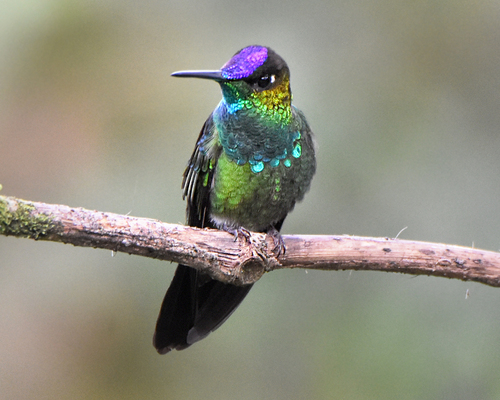
Violet-fronted Brilliant
Heliodoxa leadbeateri
A dazzling inhabitant of the Andean cloud forests, the Violet-fronted Brilliant captivates with its shimmering violet crown and acrobatic flight. This hardy hummingbird is a frequent visitor to mountain gardens, where it reigns over nectar sources with bold confidence.
Quick Identification
Size
11–13 cm (4.3–5.1 in) in length; weight approximately 6.6–8.5g (0.23–0.30 oz)
Colors
Males feature a glittering violet-blue forehead, metallic green throat and breast, and a dark forked tail. Females have white underparts with heavy green spotting and a distinct white spot behind the eye.
Key Features
- Glittering violet-blue patch on the male's forehead
- Deeply forked blue-black tail
- Straight, medium-length black bill
- White post-ocular spot behind the eye
When You’ll See Them
Geographic range
Where Does the Violet-fronted Brilliant Live?
Native to the lush mountain ranges of South America, the Violet-fronted Brilliant is a characteristic inhabitant of the Andes. Its core range spans from the coastal cordillera of Venezuela and the various Andean chains of Colombia, extending southward through the humid montane forests of Ecuador and Peru. The southern extent of its territory reaches into the yungas of Bolivia, making it a widespread species across the northern and central Andean corridor. It thrives in the mid-elevation 'cloud forest' zone, rarely venturing into the deep lowlands or the highest alpine peaks.
Basemap © OpenStreetMap contributors
Behavior
The Violet-fronted Brilliant is a high-energy hummingbird known for its bold and somewhat territorial nature. Like many members of the 'brilliant' tribe, it is a frequent visitor to flowering trees and garden feeders, where it may aggressively defend a preferred nectar source from other hummingbirds. Despite their aggression, they are also 'trap-liners,' meaning they follow a routine route between widely dispersed flowers throughout the forest.
These birds are remarkably agile fliers, capable of hovering with precision, though they often prefer to perch while feeding if a sturdy enough branch is available. In social terms, they are solitary outside of the breeding season. Humans often encounter them in gardens near forest edges, where they have become somewhat accustomed to the presence of observers, especially around well-maintained nectar stations.
EverydayEarth exclusive
Camera Tips
To capture the stunning iridescence of the Violet-fronted Brilliant, position your AI camera at eye level, roughly 4 to 6 feet off the ground. These birds are most active in the early morning light, which provides the best angle for the 'brilliant' violet forehead to catch the sun and glow for the lens. Ensure the camera is pointed slightly away from direct sunlight to avoid silhouette effects, aiming instead for soft, angled light.
One of the best tricks for photographing this species is to provide a 'staging perch.' Place a thin, natural twig about 12-18 inches away from a nectar feeder or a cluster of tubular flowers. The Violet-fronted Brilliant often pauses on a nearby branch to survey the area before feeding, giving your camera's AI plenty of time to lock focus and trigger. Set your camera's shutter speed to at least 1/2000th of a second if you want to freeze the wing motion, or use a high-frame-rate video setting (60fps or higher) to capture their hovering mechanics in slow motion.
Because they are territorial, if you have one visiting your yard, it will likely return to the same spot every 15-30 minutes. Use a camera with a fast 'wake-up' time or a pre-buffer recording feature. If using a feeder as a lure, ensure it is cleaned daily; these birds are sensitive to fermented nectar and will abandon a site that isn't well-maintained. Planting native red or orange tubular flowers like Heliconia or Fuchsia will naturally draw them into the frame without the need for artificial sugar water.
Similar Species
Species that look similar or are commonly confused with Violet-fronted Brilliant.
Green-crowned Brilliant
Lacks the violet forehead; the male has a green crown and a small blue throat patch instead.
Fawn-breasted Brilliant
Easily distinguished by its warm, buffy-cinnamon underparts instead of green and white.
Empress Brilliant
Much larger with a significantly longer tail and a more uniform dark green appearance.
Frequently Asked Questions
Record Violet-fronted Brilliant at your habitat
Connect a camera to start building your own species record — AI identifies every visitor automatically.