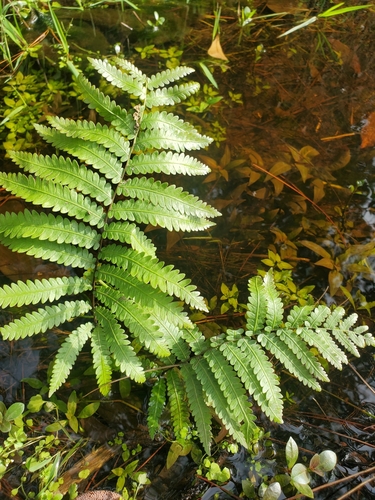
Virginia chainfern
Woodwardia virginica
A statuesque inhabitant of the American wetlands, the Virginia chainfern stands out with its polished dark stems and unique chain-link spore patterns. Unlike clumping ferns, these graceful fronds march across the bog on hidden underground paths.
Quick Identification
Size
Fronds typically reach heights of 2 to 4 feet (60–120 cm) with a width of 6 to 12 inches (15–30 cm).
Colors
Bright to deep green fronds; the lower stalk (stipe) is a distinctive glossy dark purple to charcoal black.
Key Features
- Fronds grow individually along a creeping rhizome rather than in circular clumps
- Stalk base is dark, shiny, and swollen
- Sori (spore cases) are arranged in chain-like rows along the leaf veins.
When You’ll See Them
Behavior
Unlike many common ferns that grow in tight, vase-shaped crowns, the Virginia chainfern is a wanderer. It utilizes a long, scaly underground stem called a rhizome to spread across wet landscapes. This growth habit results in tall, stately fronds that appear to pop up individually from the mud or moss, often forming expansive, airy colonies in boggy areas.
As a deciduous species, the Virginia chainfern is a seasonal highlight of the wetland. The fronds emerge in the spring, reaching their full architectural glory by mid-summer. While they don't move or interact socially like animals, they play a vital role in their ecosystem by providing cover for small amphibians and stabilizing the soft, acidic soils where other plants struggle to take root.
EverydayEarth exclusive
Camera Tips
Capturing the Virginia chainfern on camera requires a different approach than moving wildlife. Since this plant thrives in wet, often inaccessible areas, the best way to use an AI-powered trail camera is to mount it on a sturdy stake or nearby tree overlooking a known colony. To highlight the fern's unique 'chain' sori (spore cases), position the camera at a low angle, aiming slightly upward at the underside of the fronds. This perspective captures the light passing through the leaves, which makes the chain-like patterns pop against the green tissue.
Because the lower stalk (stipe) is a deep, shiny purple-black, it often gets lost in dark shadows. If you are setting up a stationary camera for time-lapse growth monitoring, ensure it is positioned to receive dappled sunlight. Mid-morning is often the 'golden hour' for ferns, as the soft light reduces the harsh contrast between the bright green leaves and the dark stems. Avoid using a heavy flash at night, as it tends to wash out the intricate textures of the pinnae.
For those interested in the 'wildlife' aspect of the fern, focus your camera on the lower third of the plant. Virginia chainferns are popular hiding spots for tree frogs and various wetland insects. By setting your camera to a 'macro' or close-focus mode and using a high-sensitivity trigger, you can capture the small creatures that use the fern's sturdy stalks as a highway or a hunting ground. If your camera supports it, a time-lapse setting of one photo every 4–6 hours during the spring will show the fascinating way the 'fiddleheads' unfurl into giant fronds.
Similar Species
Species that look similar or are commonly confused with Virginia chainfern.
Frequently Asked Questions
Record Virginia chainfern at your habitat
Connect a camera to start building your own species record — AI identifies every visitor automatically.