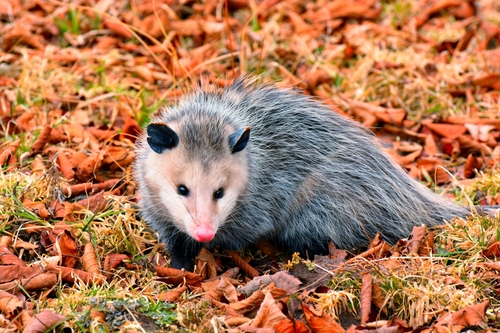
Virginia Opossum
Didelphis virginiana
Meet North America's only marsupial, a quiet nocturnal wanderer that provides free pest control for your garden. With their prehistoric looks and 'playing dead' theatrics, Virginia Opossums are one of the most misunderstood and fascinating backyard visitors.
Quick Identification
Size
Length: 13–37 in (35–94 cm); Weight: 2–14 lbs (0.8–6.4 kg). Roughly the size of a large house cat.
Colors
Frosted gray or grizzled white fur with a starkly white face; black ears often tipped with pink or white; pink nose and black feet.
Key Features
- Pointed white face with a pink nose
- Hairless, scaly, prehensile tail used for gripping
- Black, leathery ears
- Opposable 'thumb' on hind feet for climbing
When You’ll See Them
Sightings on EverydayEarth
Jul 20, 2026
A Virginia Opossum enters the scene from the right and walks across the wooded clearing. Its distinctive white face and long, naked tail are clearly visible in the infrared light as it traverses the leaf litter before moving into the shadows on the left.
Jul 17, 2026
A Virginia Opossum forages through the leaf litter, sniffing the ground intently as it crosses the wooded trail under the cover of night.
Jul 14, 2026
A Virginia Opossum enters the clearing from the right, sniffing the ground as it walks. It pauses briefly before turning around and retreating back into the shadows of the woods.
Jun 22, 2026
A Virginia Opossum is seen walking across the wooded clearing from right to left. It pauses briefly to sniff at the leaf litter before continuing out of the frame in the bottom-left corner.
Jun 20, 2026
A Virginia Opossum waddles across the forest floor at night, pausing to sniff the leaf litter as it forages through the wooded area.
Jun 19, 2026
A juvenile Virginia Opossum is perched on top of the black squirrel baffle. It actively sniffs the pole and looks upward toward the feeders, likely searching for a path to reach the fruit and seeds above.
Behavior
The Virginia Opossum is North America’s only marsupial, a fascinating survivor that has remained largely unchanged for millions of years. They are famous for their involuntary defense mechanism known as 'playing possum.' When faced with an overwhelming threat, their body enters a comatose-like state, emitting a foul odor to convince predators that they are already dead and decaying. Beyond this dramatic display, they are peaceful, solitary creatures that prefer to avoid conflict.
In the backyard ecosystem, opossums are incredibly beneficial 'sanitation workers.' They are meticulous groomers and have a voracious appetite for ticks, reportedly consuming up to 5,000 in a single season. They also possess a remarkable immunity to the venom of most local snakes, including copperheads and rattlesnakes. While they are nomadic by nature, a mother with young (called joeys) may stay in an area longer, eventually carrying her growing brood on her back in a display that is a favorite for trail camera enthusiasts.
EverydayEarth exclusive
Camera Tips
To get the best shots of a Virginia Opossum, positioning is everything. Place your camera low—about 10 to 12 inches off the ground—and aim it along 'travel corridors.' Opossums love to hug the edges of structures, so fence lines, the base of retaining walls, or the perimeter of a woodpile are high-traffic zones. Because they are slow-moving foragers, set your camera to take video clips of at least 20 seconds. This allows you to see their unique 'waddling' gait and how they use their prehensile tail for balance or for carrying nesting materials like leaves.
A major challenge with opossums is their bright white face. At night, standard infrared flashes can easily 'blow out' the image, leaving you with a glowing white orb where the face should be. If your camera has adjustable flash settings, set it to 'Medium' or 'Power Save' mode. Alternatively, place the camera at a 45-degree angle to the trail rather than head-on; this reduces the direct bounce-back of light and preserves the detail of their dark eyes and pink noses.
If you want to encourage a visit for the camera, you don't need complex lures. A small smear of jam, a few pieces of overripe banana, or even a handful of cat kibble near a hollow log will stop them long enough for a great sequence. In the late spring, keep your camera active near any brush piles or under-deck cavities. This is when you are most likely to capture the 'holy grail' of opossum footage: a mother carrying her entire litter of joeys on her back. Since they are year-round residents, don't put the camera away in winter; they remain active even in the snow, though they may move more slowly to conserve energy.
Similar Species
Species that look similar or are commonly confused with Virginia Opossum.
Frequently Asked Questions
Record Virginia Opossum at your habitat
Connect a camera to start building your own species record — AI identifies every visitor automatically.