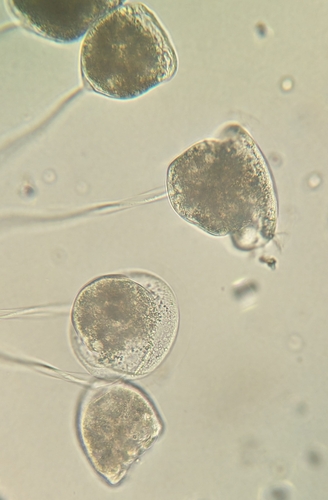
Vorticella
Vorticella campanula
Meet the microscopic acrobat of the pond world. Vorticella campanula is a stunning, bell-shaped organism that anchors itself to underwater plants and uses a high-speed spring-loaded stalk to vanish from sight at the first sign of danger.
Quick Identification
Size
Body (zooid) 50-150 micrometers (0.002-0.006 in); Stalk up to 1 mm (0.04 in)
Colors
Translucent or transparent, occasionally showing faint yellowish or greenish tints from internal food vacuoles
Key Features
- Translucent bell-shaped body known as a zooid
- Long, highly contractile stalk that coils like a spring
- Ciliary wreath at the top used to create water currents
When You’ll See Them
Behavior
Vorticella campanula is a fascinating "bell animalcule" that spends its life anchored to submerged surfaces like aquatic plants, stones, or even the shells of tiny crustaceans. While they are technically solitary organisms, they are social in nature, often appearing in large groups that resemble a microscopic forest. Each individual acts independently, using a crown of hair-like cilia to create a miniature whirlpool, or vortex, in the water to pull in food particles.
The most distinctive behavior of Vorticella is its incredible "startle response." When it senses a vibration or a threat, the long stalk instantly coils into a tight spiral, pulling the bell-shaped body down toward the surface it is attached to. This movement is one of the fastest in the biological world, occurring in a fraction of a second. After the perceived danger passes, the stalk slowly uncurls and extends, allowing the organism to resume its filter feeding.
EverydayEarth exclusive
Camera Tips
Capturing Vorticella campanula requires a departure from traditional trail cameras; instead, you will need a digital microscope or a high-magnification macro lens attachment for your smartphone. To find them, collect a sample of submerged aquatic vegetation, such as pondweed or moss, from a clean, non-stagnant freshwater source. Because Vorticella campanula specifically avoids contaminated water, look for clear ponds with healthy plant life rather than stagnant, murky puddles.
Place your plant sample in a shallow petri dish or a well-slide with enough pond water to keep it submerged. When setting up your camera, lighting is your most important tool. Because Vorticella are translucent, standard brightfield lighting (light from directly below) can make them look washed out. Try using "oblique illumination" by tilting your light source or using a darkfield filter; this will make the delicate bell and the coiling stalk glow against a dark background, revealing incredible structural detail.
To capture the best video footage, use a high-speed or slow-motion setting (at least 120 frames per second). This is the only way to clearly see the mechanics of the stalk coiling, as the movement is too fast for standard video to record without blurring. Set your focus on the "zooid" (the bell part) and wait. If you want to trigger the contraction for the camera, a very gentle tap on the microscope stage or the edge of the slide will usually provide enough vibration to send the Vorticella into its signature spiral.
Similar Species
Species that look similar or are commonly confused with Vorticella.
Frequently Asked Questions
Record Vorticella at your habitat
Connect a camera to start building your own species record — AI identifies every visitor automatically.