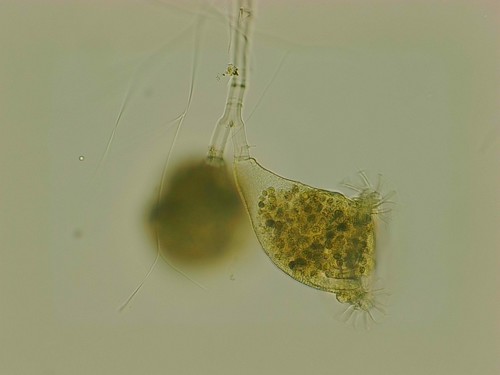
Epistylis
Campanella umbellaria
Step into the microscopic world to discover Campanella umbellaria, a stunning colonial organism that looks like a forest of crystal umbrellas. Common in garden ponds, these tiny architects are nature's hidden water purifiers.
Quick Identification
Size
Individual cells 80–120 µm; colonies can reach 1–2 mm (0.04–0.08 inches) in length
Colors
Translucent or milky white; may appear greenish if symbiotic algae are present
Key Features
- Bell-shaped body (zooid) atop a long stalk
- Branching colonial structure resembling an inverted umbrella
- Ciliary wreath at the top used for creating water currents
- Non-contractile stalks that do not snap back when disturbed
When You’ll See Them
Geographic range
Where Does the Epistylis Live?
Campanella umbellaria is a cosmopolitan species found across nearly every continent, thriving wherever there is stable, oxygenated freshwater. While native to most temperate and tropical regions of the Northern Hemisphere, including the United States, Canada, and across Europe, it has also been widely documented in South America and Australia. As long as the water temperature remains above freezing and contains a healthy bacterial population, this resilient protist can be found in almost any backyard pond or local wetland.
Basemap © OpenStreetMap contributors
Behavior
Campanella umbellaria is a fascinating colonial ciliate that lives a sessile life, meaning it spends its adult stage attached to a substrate. These organisms create elaborate, tree-like structures where dozens of individual bell-shaped cells (zooids) share a branching stalk system. Unlike many of their relatives, their stalks lack a contractile 'myoneme,' so they do not snap back into a coil when startled. Instead, they remain elegantly extended as they filter the water.
These micro-animals are often found in a symbiotic or 'phoretic' relationship with larger aquatic creatures. It is common to find a colony of Campanella umbellaria hitching a ride on the shell of a pond snail or the exoskeleton of a dragonfly nymph. This allows the colony to travel to new water patches rich in bacteria without needing to swim, while the host remains largely unharmed by its microscopic passengers.
EverydayEarth exclusive
Camera Tips
Capturing Campanella umbellaria requires a shift from traditional trail cameras to macro or microscopic imaging. To see these 'backyard' residents, you will need a digital microscope or a smartphone with a high-powered macro lens attachment (at least 15x magnification). The best way to find them is to collect a small sample of pond water along with a piece of submerged vegetation or a decaying leaf, as the colonies cling to these surfaces.
Once you have your sample, place it in a shallow glass dish or on a well-slide. Lighting is the most critical factor for success. Use 'darkfield illumination'—lighting the sample from the side or from below at an angle—to make the translucent bodies of the ciliates glow against a dark background. This highlights the delicate cilia and the branching structure of the stalks, making it much easier for AI-powered identification tools to recognize the species.
For the best video footage, look for the movement of the 'ciliary wreath' at the top of the bells. Set your camera to a high frame rate if possible, as the beating of the cilia is very rapid. If you are trying to capture them in a backyard pond without removing them, use an underwater macro camera positioned near submerged rocks or plant stems in still water. Since they are active day and night, time of day is less important than water clarity and light quality.
Similar Species
Species that look similar or are commonly confused with Epistylis.
Vorticella
Vorticella are usually solitary or in small clusters and have highly contractile stalks that snap back when disturbed.
Carchesium
Carchesium is also colonial and branching, but unlike Campanella, each individual branch can contract independently.
Epistylis
Epistylis is a closely related genus; Campanella is distinguished by the more complex, umbrella-like branching pattern of its colony.
Frequently Asked Questions
Record Epistylis at your habitat
Connect a camera to start building your own species record — AI identifies every visitor automatically.