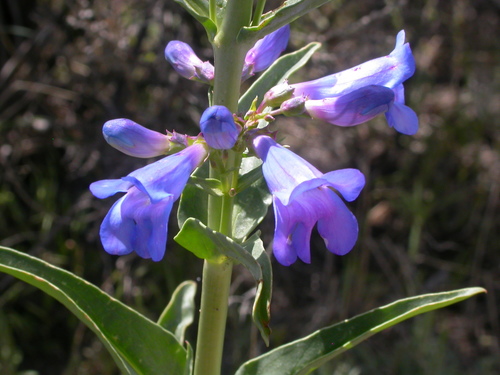
Wasatch Beardtongue
Wildflowers diurnal

Wasatch Beardtongue

Penstemon cyananthus

A stunning burst of electric blue, the Wasatch Beardtongue is the crown jewel of the Intermountain West’s wild gardens. This hardy perennial transforms rocky slopes into vibrant pollinator highways every spring.

0 Sightings
0 Habitats

Quick Identification

straighten

Size

12-40 inches (30-100 cm) tall; flower spikes can reach up to 10 inches (25 cm) in length

palette

Colors

Deep electric blue to bright azure blossoms; waxy, medium-green foliage

visibility

Key Features

  • Dense spikes of tubular, two-lipped blue flowers
  • Opposite, broad, heart-shaped leaves at the base
  • Distinctive hairy sterile stamen (the 'beardtongue') visible inside the bloom
  • Stiff, upright stems that resist drooping

When You’ll See Them

schedule
Activity pattern diurnal
brightness_5
Peak hours 8 AM - 6 PM (Peak pollinator activity)
calendar_month
Season May-July
restaurant
Diet Autotrophic; generates energy via photosynthesis. Thrives in full sun and requires well-drained, lean soil.
park
Habitat Mountain slopes, sagebrush steppes, and rocky suburban garden borders at elevations between 5,000 and 10,000 feet.

bar_chart
Loading activity data...

Behavior

The Wasatch Beardtongue is a perennial wildflower that defines the late spring landscape of the Intermountain West. While stationary, it exhibits a 'behavioral' rhythm dictated by the sun and moisture; its blooms open progressively from the bottom of the stalk upward to maximize the window for pollination. It is a social plant, often found in large, vibrant colonies that create a 'blue mist' effect on mountain foothills.

In a backyard setting, it acts as a central hub for local biodiversity. It is relatively short-lived as an individual plant, usually lasting 3-5 years, but it successfully self-seeds in well-drained, gravelly soils. Its primary 'interaction' with humans is through its popularity in xeriscaping, providing a massive burst of color with very little water once established.

photo_camera EverydayEarth exclusive

Camera Tips

To capture the wildlife attracted to Wasatch Beardtongue, place your camera on a tripod or mount just 2-3 feet away from the most active flower spikes. Because the blue color of the blooms is so intense, it can sometimes 'blow out' in direct midday sun. For the best photos and videos, position your camera so it faces east or west to catch the softer 'golden hour' light, which makes the electric blue petals truly pop against the green foliage.

Set your camera to a high-speed trigger or video mode. This species is a magnet for broad-tailed hummingbirds and various species of bumblebees and mason bees. If your camera allows for manual focus, focus on the 'throat' of a prominent blossom near the center of the spike, as this is where pollinators will linger the longest while feeding. A side-profile angle is generally better than a top-down view for capturing the interaction between the insect and the flower's 'beardtongue' stamen.

Because this plant thrives in breezy, open areas, wind can often cause 'false triggers' on motion-activated cameras. To mitigate this, use a camera with 'Zone Detection' to focus only on the area immediately around the flowers, or reduce the sensitivity settings during the afternoon when mountain breezes are strongest. If you are using an AI-powered camera, the Wasatch Beardtongue serves as a perfect 'natural lure'—no additional bait is needed, as the high-quality nectar is the primary draw for local fauna.

Frequently Asked Questions

You will see the most activity from mid-morning to early afternoon (9 AM - 2 PM) when temperatures are warm enough for bees and hummingbirds to be highly active, and the nectar production is at its peak.
The plant does the work for you! Its tubular shape is perfectly evolved for hummingbird beaks. To maximize visits, plant them in groups of three or more to create a large visual 'target' of blue that birds can see from a distance.
They require full sun and exceptionally well-drained soil. Overwatering or heavy clay soil is the most common cause of failure, as their roots are prone to rot if kept too wet during the winter.
They are increasingly common in suburban 'water-wise' gardens throughout Utah, Idaho, and Wyoming, and can be found growing wild along canyon roads and hiking trails near residential edges.
Look at the leaves: Wasatch Beardtongue (P. cyananthus) has wider, more heart-shaped leaves that often clasp the stem, while Rocky Mountain Penstemon (P. strictus) has much narrower, linear leaves and usually a more purple-toned flower.

Record Wasatch Beardtongue at your habitat

Connect a camera to start building your own species record — AI identifies every visitor automatically.

Join free Identify a photo