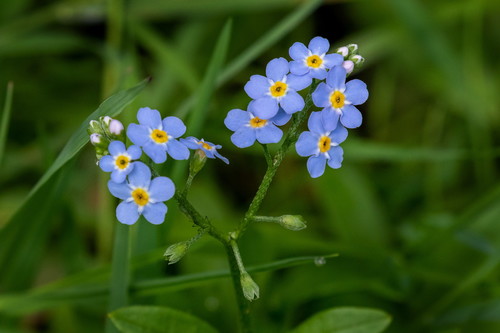
water forget-me-not
Myosotis scorpioides
The water forget-me-not is a sprawling, sky-blue gem that turns muddy banks into living tapestries. A favorite of poets and pollinators alike, its unique 'scorpion-tail' blooms are a sign of a healthy, hydrated ecosystem.
Quick Identification
Size
Grows 15 to 60 cm (6 to 24 inches) tall with a spreading, creeping habit that can cover several feet of ground.
Colors
Brilliant sky-blue petals with a distinct yellow center (the 'eye'); buds often appear pink or purple before fully opening.
Key Features
- Five-petaled sky-blue flowers with yellow centers
- Coiled flower heads that unfurl like a scorpion's tail
- Oblong, hairy green leaves arranged alternately
- Creeping stems that often root at the nodes in wet soil
When You’ll See Them
Behavior
The water forget-me-not is a hardy perennial that thrives in the 'liminal' spaces of your backyard—the soggy edges where land meets water. Unlike its woodland cousins, this species is semi-aquatic, often sending its succulent, hairy stems directly into shallow, slow-moving water. It spreads through a creeping root system (stolons), creating lush mats of foliage that provide excellent cover for small amphibians and aquatic insects.
As a biological clock for the garden, its flowering cycle is a highlight of the late spring and summer. The flowers are arranged in a 'scorpioid cyme,' meaning the flower spike curls like a scorpion's tail, gradually straightening as each tiny blossom opens from the base upward. This provides a consistent nectar source for weeks, making it a social hub for hoverflies, small bees, and even the occasional butterfly seeking a drink at the water's edge.
EverydayEarth exclusive
Camera Tips
To capture the true beauty of the water forget-me-not, position your camera at a 'frog's eye view.' This species stays relatively low to the ground, so a camera mounted on a standard tripod will miss the intricate details of the yellow 'eye' and the delicate hairs on the stem. Use a ground-stake mount or a low-profile weighted base placed right at the edge of your pond or stream. Aim for a slightly upward angle to capture the blue of the petals against the sky or green background foliage.
Because these flowers are small (usually 5-10mm across), macro settings or a dedicated macro lens are essential if you want your AI camera to trigger on movement. If your camera allows for focus zones, set the zone specifically on a cluster of buds. This is where the action happens; as the 'scorpion tail' unfurls, the movement is slow, but the pollinators it attracts are fast. High-speed shutter settings are recommended to freeze the wings of visiting syrphid flies, which are the primary fans of this plant.
Time-lapse is your best friend with this species. Set your camera to take a photo every 15-30 minutes during the peak of June. Over a week, you will capture the fascinating way the flower spike uncurls and 'straightens' out. Additionally, because this plant grows in wet areas, be mindful of glare. Water reflects light intensely, which can wash out the delicate blue of the petals. Try to position the camera so the sun is behind it or use a lens hood to minimize lens flare during the mid-afternoon hours.
Finally, consider the seasonal transition. In late spring, the buds are a vibrant pink, turning blue as they open. Setting your camera early in the season allows you to document this color shift. If you are using an AI-powered camera to track wildlife, the forget-me-not patch is an ideal 'stage'—it naturally attracts small frogs and dragonflies who use the floating mats as hunting platforms, giving you a two-for-one deal on your wildlife footage.
Similar Species
Species that look similar or are commonly confused with water forget-me-not.
Frequently Asked Questions
Record water forget-me-not at your habitat
Connect a camera to start building your own species record — AI identifies every visitor automatically.