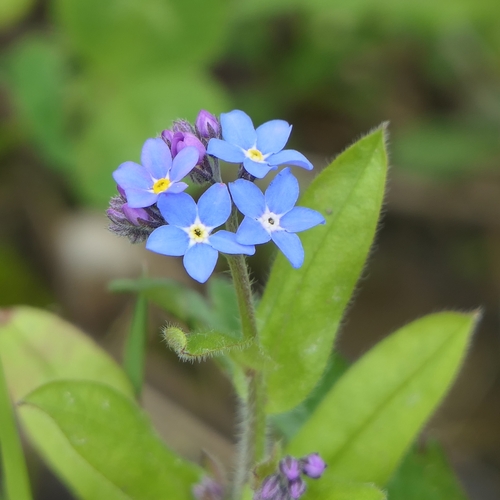
Wood Forget-me-not
Myosotis sylvatica
A woodland treasure that carpets the forest floor in azure, the Wood Forget-me-not is a springtime favorite for gardeners and pollinators alike. Its delicate blue petals and bright yellow centers provide a stunning contrast in the shaded corners of any backyard.
Quick Identification
Size
Stands 12-30 cm (5-12 inches) tall with a spread of approximately 15-20 cm (6-8 inches).
Colors
Brilliant azure-blue petals with a distinct yellow 'eye' at the center; buds often appear pink or purple before fully opening.
Key Features
- Five-petaled sky blue flowers in coiled clusters
- Hairy, stalkless, oblong-shaped green leaves
- Characteristic yellow central ring or 'eye'
- Lower leaves form a basal rosette
When You’ll See Them
Behavior
Wood Forget-me-nots are enchanting short-lived perennials or biennials that act as a primary nectar source for early-season pollinators. In the wild, they follow a 'cyme' growth pattern, where the flower stalks uncurl like a scorpion's tail as the blooms open sequentially. This ensures a prolonged flowering period that maximizes the chances of pollination by small bees, hoverflies, and butterflies.
In a backyard setting, these plants are famous for their prolific self-seeding. They are not aggressive in a way that harms the ecosystem, but they will happily wander across shaded borders, filling in gaps between larger shrubs. They exhibit a 'pioneer' behavior, often being among the first flowers to emerge in woodland clearings after the canopy has been disturbed or in the early spring before the trees fully leaf out.
EverydayEarth exclusive
Camera Tips
Capturing the Wood Forget-me-not requires a different approach than fast-moving wildlife. Because these plants sit low to the ground, you should mount your AI-powered camera on a low-profile stake or a specialized ground mount, positioned only 6 to 10 inches above the soil. Angle the lens slightly upward to capture the underside of the petals and the delicate hairs on the stems, which add incredible texture to high-definition photos.
Since plants don't trigger traditional PIR (Passive Infrared) motion sensors effectively, switch your camera to 'Time-Lapse' mode. Setting an interval of one photo every 15-30 minutes during daylight hours will allow you to create a stunning sequence of the 'scorpion tail' flower stalks uncurling over several days. If your camera supports it, use a macro lens attachment or ensure the focus is set to 'near' to avoid the camera blurring the small flowers in favor of the background foliage.
Lighting is the most critical factor for these bright blue blooms. The best shots occur during the 'Golden Hour'—shortly after sunrise—when the morning dew is still clinging to the hairy leaves. The soft, angled light prevents the blue colors from looking washed out, which can happen in harsh midday sun. If your backyard is particularly shady, look for 'dappled light' opportunities where sunlight breaks through the tree canopy, creating a natural spotlight on the flower patch.
For those interested in the 'wildlife' aspect of the Wood Forget-me-not, place the camera in 'Hybrid Mode' (Photo + Video) during the peak of a warm May afternoon. This is when hoverflies and beeflies are most active. By focusing on a specific cluster of blooms, you can capture high-speed interactions that would be missed by the naked eye, providing a fascinating look at the plant's role in your local ecosystem.
Similar Species
Species that look similar or are commonly confused with Wood Forget-me-not.
Frequently Asked Questions
Record Wood Forget-me-not at your habitat
Connect a camera to start building your own species record — AI identifies every visitor automatically.