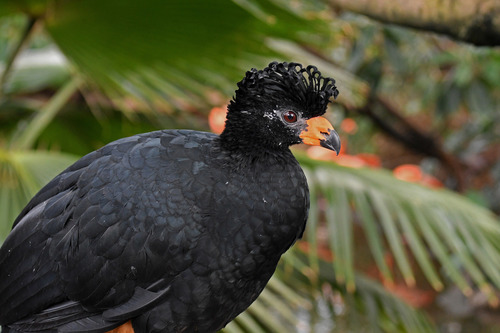
Wattled Curassow
Crax globulosa
The Wattled Curassow is a crown jewel of the Amazonian understory, known for its striking curly crest and elusive nature. Seeing one in the wild is a rare privilege, as these endangered birds represent the pristine health of the remote rainforests they call home.
Quick Identification
Size
Length: 82–89 cm (32–35 in); Weight: approx. 2.5 kg (5.5 lbs)
Colors
Males are glossy black with a white lower belly (crissum) and bright red fleshy ornaments on the bill. Females are black with a reddish-buff lower belly and lack the red bill wattles.
Key Features
- Distinctive curly black head crest
- Bright red globose ornaments at the base of the male's bill
- Large, turkey-sized body with a long tail
- White or reddish-buff undertail area contrasting with black plumage
When You’ll See Them
Behavior
The Wattled Curassow is a highly terrestrial bird, spending much of its day walking across the forest floor in search of food. Despite their large size, they are remarkably stealthy and shy, often heard before they are seen. They are known for their deep, low-frequency booming calls, which males use during the breeding season to establish territory and attract mates. These calls are so low that they can be difficult for human ears to locate precisely in the dense rainforest.
Socially, they are usually found in pairs or small family groups. When threatened, they prefer to run into thick undergrowth rather than fly, though they are capable of strong, short bursts of flight to reach high roosting branches for the night. Their interaction with humans is historically limited due to their remote habitat and extreme wariness, making them a 'holy grail' species for wildlife photographers and researchers.
EverydayEarth exclusive
Camera Tips
Capturing the Wattled Curassow on camera requires patience and strategic placement, as they are incredibly sensitive to new objects in their environment. Because they spend the majority of their time on the ground, your camera should be mounted low—approximately 18 to 24 inches off the forest floor. Angle the lens slightly upward if you are on a slope, or keep it level on flat terrain. Target 'animal highways' or narrow trails along the edges of lagoons and riverbanks, as these birds often use clear paths to move between foraging sites and water sources.
Since these birds inhabit the deep, dark understory of the Amazon, camera sensors with high low-light sensitivity are essential. Set your camera to a fast trigger speed (0.3 seconds or less) because, while they walk slowly when foraging, they can disappear in a flash if startled. If you are in a legal and ecologically sensitive area for baiting, native fallen fruits like those from the Ficus or Palmae families can act as a natural lure, but the best 'bait' is often a known active lek or booming ground during the breeding season.
To avoid spooking these birds, use 'No-Glow' or black infrared LEDs for nighttime or low-light shots. Even the faint red glow of standard IR can cause a wary curassow to avoid the area in the future. Check your cameras during the middle of the day when activity is lowest to minimize the chance of a face-to-face encounter that could drive them away from your site permanently. Ensure your housing is waterproof and includes desiccant packs, as the high humidity of the curassow's habitat is notorious for fogging lenses.
Similar Species
Species that look similar or are commonly confused with Wattled Curassow.
Frequently Asked Questions
Record Wattled Curassow at your habitat
Connect a camera to start building your own species record — AI identifies every visitor automatically.