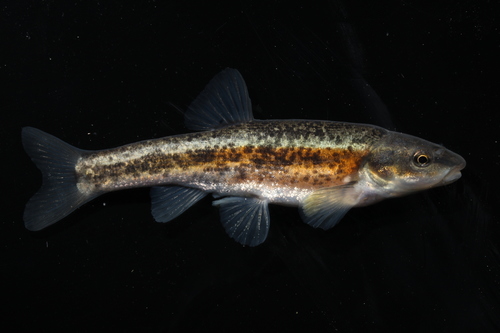
Western Blacknose Dace
Rhinichthys obtusus
Meet the Western Blacknose Dace, the sleek 'racing stripe' minnow of North America's clear-running streams. These small but hardy fish are a sign of a healthy aquatic ecosystem right in your backyard.
Quick Identification
Size
2 to 3 inches (5–7.6 cm) in length, with a maximum size of 4 inches (10 cm).
Colors
Tan to dark brown backs with cream-colored undersides; a bold dark lateral stripe runs from the snout to the tail, which turns a rusty pink in males during the spawning season.
Key Features
- Prominent dark mid-lateral stripe from snout to tail
- Small, nearly invisible scales giving a smooth appearance
- Slightly sub-terminal mouth (snout hangs slightly over the mouth)
- Single dorsal fin with 8 rays and no spines
When You’ll See Them
Behavior
The Western Blacknose Dace is a highly active and energetic species often found in the riffles and clear pools of small streams. They are social creatures, typically seen in small schools where they dart among rocks and submerged debris. Their movement is characterized by quick, jerky bursts, which helps them navigate the moving water of their preferred creek habitats.
In the presence of humans or larger predators, they are quick to hide under stones or within vegetation. However, for those with backyard streams, they are fascinating to watch as they perform 'cleaning' behaviors, picking through the substrate for food. During the spring, their behavior becomes more territorial and animated as males develop vibrant colors and compete for the best spawning sites on gravelly bottoms.
EverydayEarth exclusive
Camera Tips
To capture high-quality footage of the Western Blacknose Dace, you will need a waterproof action camera or a dedicated underwater trail camera. Position your camera in a shallow 'riffle' area where water flows over stones, or at the edge of a pool just downstream from a small waterfall. Use a weighted tripod or a flat river stone to anchor the camera firmly against the current, ensuring the lens is submerged but stable.
For the best clarity, aim your camera horizontally across a flat patch of gravel or at a large, algae-covered rock that serves as a natural feeding station. Lighting is the biggest challenge underwater; try to film on sunny days when light penetrates the water column, or use a camera with a high-lumen white LED for evening shots. Avoid using infrared at night if the water is murky, as it will cause 'backscatter' (reflecting off particles and blurring the image).
To draw the dace into the frame, you can gently kick up a bit of upstream sediment to release natural larvae, or place a small mesh bag of fish food just out of sight behind a rock in the camera's view. Set your camera to record at 60 frames per second (fps) if possible; these fish move extremely fast, and the higher frame rate will allow you to watch their darting movements in smooth slow-motion during playback. Late May and June are the best times to record, as the males' bright rusty stripes make them stand out vividly against the grey stones.
Similar Species
Species that look similar or are commonly confused with Western Blacknose Dace.
Eastern Blacknose Dace
Nearly identical, but geographically separated; the Eastern species typically has slightly different scale counts and is found east of the Appalachians.
Longnose Dace
Features a significantly longer snout that projects well past the mouth and lacks the distinct dark lateral racing stripe.
Creek Chub
Grows much larger (up to 12 inches) and has a distinct black spot at the front base of the dorsal fin.
Frequently Asked Questions
Record Western Blacknose Dace at your habitat
Connect a camera to start building your own species record — AI identifies every visitor automatically.