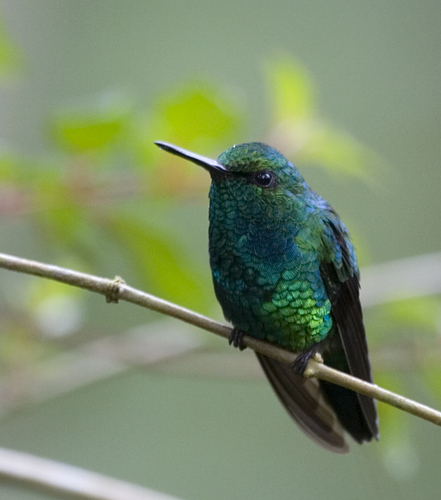
Western Emerald
Chlorostilbon melanorhynchus
A living jewel of the Andes, the Western Emerald dazzles with its metallic green feathers and acrobatic flight. This tiny dynamo is a frequent visitor to Colombian and Ecuadorian gardens, bringing a flash of brilliance to every flower it visits.
Quick Identification
Size
Length: 7.5–8 cm (2.9–3.1 in); Weight: 2.5–3.2 g (0.09–0.11 oz)
Colors
Males are a brilliant, shimmering emerald green throughout with a blue-black forked tail. Females are bronze-green above with light grey underparts and a white spot behind the eye.
Key Features
- Glistening metallic green plumage in males
- Straight, entirely black bill
- Deeply forked blue-black tail
- Distinctive white post-ocular spot in females
When You’ll See Them
Geographic range
Where Does the Western Emerald Live?
Native to the lush landscapes of South America, the Western Emerald is a specialist of the northern Andean region. It is most commonly found along the western slopes and inter-Andean valleys of Colombia and Ecuador, thriving in the transition zones between lowland forests and montane environments. While it has a relatively restricted global range, it is remarkably adaptable to human-modified landscapes, making it a staple of suburban gardens within its core territory.
Basemap © OpenStreetMap contributors
Behavior
The Western Emerald is a high-energy acrobat, constantly on the move as it darts between flowering shrubs and trees. Like many emeralds, they are highly territorial and will aggressively defend a rich nectar source from other hummingbirds, often emitting sharp, rapid chirps while chasing intruders away. Their flight is characterized by rapid, jerky movements and a low, buzzing sound produced by their wings.
While they are primarily solitary, they are frequently seen in backyard gardens and coffee plantations, where they have become somewhat accustomed to human presence. They do not migrate, remaining in their Andean territories year-round, which makes them a reliable subject for local birdwatchers and backyard camera enthusiasts.
EverydayEarth exclusive
Camera Tips
To capture the iridescent 'glow' of a Western Emerald, lighting is everything. Position your camera so the sun is behind you, shining directly onto the bird's chest; this ensures the structural colors of the feathers reflect back into the lens. If the bird is backlit, it will simply appear as a dark silhouette. Aim for a 45-degree angle downward if possible to capture the brilliance of the crown and back.
Because these birds move at incredible speeds, you'll need a camera with a fast trigger and a high shutter speed—ideally 1/2000 of a second or faster to freeze the wing motion. If you are using an AI-powered backyard camera, place it within 2-3 feet of a red or purple tubular flower patch or a hummingbird feeder. Ensure the background is at least 6-10 feet away to create a beautiful 'bokeh' effect that makes the emerald green plumage pop.
Native plants like Fuchsia or Salvia are far more effective than generic feeders for attracting this specific species. These birds are creatures of habit; once they identify a reliable food source in your yard, they will return to the same perch every few minutes. Observe where they sit to rest between feedings and aim your camera at that specific branch—this is often where you will get your sharpest, most detailed 'hero' shots.
Similar Species
Species that look similar or are commonly confused with Western Emerald.
Frequently Asked Questions
Record Western Emerald at your habitat
Connect a camera to start building your own species record — AI identifies every visitor automatically.