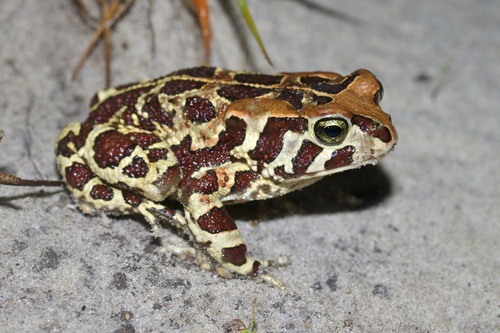
Western Leopard Toad
Sclerophrys pantherina
A vibrant jewel of the Cape, the Western Leopard Toad is famous for its striking patterns and its dramatic annual migration through suburban streets. These 'garden giants' are a testament to how wild wonders can persist right in our backyards.
Quick Identification
Size
75–140 mm (3–5.5 inches) in length; weight varies but females are notably larger and heavier than males.
Colors
Striking yellow to olive-brown background with large, well-defined chocolate-brown to reddish-brown blotches; a distinct pale yellow line runs down the center of the back.
Key Features
- Bold chocolate-brown leopard-like spots
- Pale yellow stripe running down the middle of the back
- Large, prominent parotoid glands behind the eyes
- Reddish-pink coloring on the inner thighs
When You’ll See Them
Geographic range
Where Does the Western Leopard Toad Live?
Native to the African continent, the Western Leopard Toad is a high-profile specialist found exclusively in a tiny corner of South Africa. This charismatic amphibian resides only in the low-lying coastal regions of the Western Cape, specifically spanning the Cape Peninsula, the Cape Flats, and the Agulhas flats. Because it is endemic to such a small, urbanized area, it is frequently found in residential neighborhoods where original fynbos or wetland habitats remain nearby.
Basemap © OpenStreetMap contributors
Behavior
The Western Leopard Toad is a largely terrestrial and nocturnal species that spends most of its life away from water, often taking up residence in suburban gardens. They are known for their explosive breeding events, usually triggered by the first heavy rains in August, where hundreds of individuals migrate from gardens and thickets to traditional breeding ponds. During this time, the males produce a deep, snoring call that can be heard from several hundred meters away.
Outside of the breeding season, they are solitary hunters that hide in cool, damp spots during the day—such as under logs, rocks, or in thick vegetation—and emerge at night to forage. While they are generally docile, they are highly vulnerable to human infrastructure; their slow-moving nature makes them frequent victims of road traffic during their annual migrations, leading to major community-led conservation efforts in Cape Town.
EverydayEarth exclusive
Camera Tips
Placement is everything for these ground-dwellers. Set your AI-powered camera at or near ground level, ideally angled slightly downward. Focus on 'toad highways'—damp corridors, the edges of flower beds, or the perimeter of garden ponds. Since they are nocturnal, ensure your camera's night vision or infrared sensor is clean and unobstructed to capture the fine details of their skin patterns.
While we don't recommend using food bait which might attract pests or disrupt natural hunting, you can attract them with a 'light trap.' Position your camera near a low-wattage garden light that attracts nocturnal insects like moths and beetles. The toads will quickly learn that these spots are easy buffets, providing plenty of opportunities for high-quality, close-up captures.
Timing is critical for the best footage. While they are present year-round, the most spectacular activity occurs during the breeding migration in August. During these rainy nights, toads are on the move and much more visible. Increase your camera's motion sensitivity during this period and consider setting it to capture short video clips rather than just stills to catch their characteristic 'slow-motion' crawl and hear the male's deep snore.
Ensure your camera is properly waterproofed against the Western Cape's winter rains. Check that the lens is clear of low-lying grass blades that might trigger false positives in the wind. Since these toads move relatively slowly, a medium trigger speed is usually sufficient, but high-resolution settings are recommended to capture the intricate, leopard-like markings that make this species unique.
Similar Species
Species that look similar or are commonly confused with Western Leopard Toad.
Frequently Asked Questions
Record Western Leopard Toad at your habitat
Connect a camera to start building your own species record — AI identifies every visitor automatically.