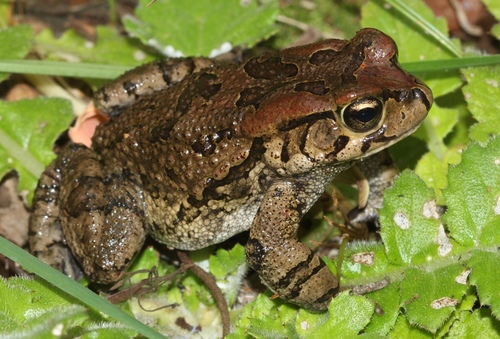
Raucous Toad
Sclerophrys capensis
A robust garden guardian with a voice like a duck, the Raucous Toad is a common and charismatic visitor to Southern African backyards. Its symmetrical markings and bold nighttime hunting make it a perfect subject for ground-level wildlife cameras.
Quick Identification
Size
3 to 4.7 inches (7.5 to 12 cm) in length; roughly 2 to 5 oz (60 to 140 g)
Colors
Olive-brown to grayish-brown with dark, reddish-brown symmetrical blotches; pale creamy white underside
Key Features
- Large parotoid glands behind the eyes
- Two dark brown patches between the eyes forming a broken bar or V-shape
- Warty, textured skin with symmetrical patterns
- Robust, stocky build with short limbs
When You’ll See Them
Geographic range
Where Does the Raucous Toad Live?
The Raucous Toad is a native resident of Southern Africa, with its core populations thriving across the southern and eastern regions of South Africa. Its range extends northwards into the high-altitude grasslands of Lesotho and Eswatini, reaching as far as southern Zimbabwe and parts of eastern Namibia and Mozambique. This species is particularly common along the Great Escarpment and coastal plains, where it successfully bridges the gap between wild bushveld and human-altered landscapes.
Basemap © OpenStreetMap contributors
Behavior
The Raucous Toad is a bold and highly adaptable amphibian, often making itself at home in the bustling environment of a suburban garden. Primarily nocturnal, these toads emerge from their daytime retreats—usually under rocks, logs, or in thick mulch—as the sun sets. They are famous for their unique hunting strategy: they often congregate under outdoor porch lights, where they wait for the glow to attract a steady stream of moths and beetles for an easy meal.
During the breeding season, their behavior becomes significantly more conspicuous. Males travel to permanent water sources and establish calling territories. Unlike many other toads that emit a high-pitched trill, the Raucous Toad produces a loud, rasping sound that is frequently mistaken for a duck's quack. They are terrestrial and prefer walking or making short hops over long-distance jumping, giving them a heavy, deliberate movement style.
EverydayEarth exclusive
Camera Tips
To successfully capture a Raucous Toad on your backyard camera, placement is everything. These toads are creatures of habit and will often visit the same 'hunting grounds' night after night. Position your camera at ground level, no more than 4 to 6 inches (10-15 cm) above the earth, and tilt it slightly upward. The best locations are near artificial light sources, such as garden path lights or beneath a porch light, where the toad will naturally wait for insects to fall.
If you have a pond or a leaky outdoor tap, these are prime real estate for a Raucous Toad. Set your camera near the water's edge, focusing on a flat rock or patch of bare soil. Since they move slowly and spend a lot of time sitting still, a standard trigger speed will work, but you should adjust your 'PIR Sensitivity' to high to ensure the camera detects the subtle movement of a cold-blooded animal. Most trail cameras have a minimum focus distance of about 3 to 5 feet; ensure you aren't placing the camera too close, or the toad will appear as a blurry brown blob.
Timing is critical for the best footage. You will see the most activity on warm, humid nights, particularly immediately after a rainstorm. If your camera supports video with audio, ensure it is enabled—the Raucous Toad's distinctive quacking call is one of its most fascinating features and is essential for a complete recording of its behavior. Avoid using white-flash cameras as they can startle the toad; 'No-Glow' or 'Low-Glow' infrared LEDs are much better for capturing natural feeding behavior without causing the toad to retreat.
Similar Species
Species that look similar or are commonly confused with Raucous Toad.
Frequently Asked Questions
Record Raucous Toad at your habitat
Connect a camera to start building your own species record — AI identifies every visitor automatically.