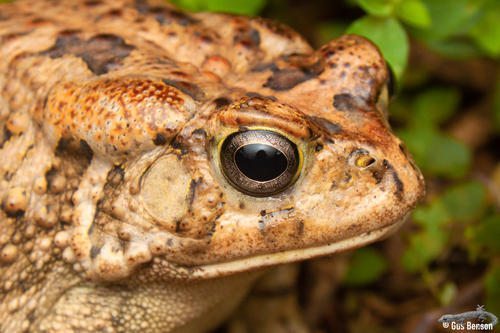
Guttural Toad
Sclerophrys gutturalis
Meet the Guttural Toad, the charismatic nighttime guardian of African gardens. Known for its deep snoring call and bold personality, this adaptable amphibian is a master of pest control.
Quick Identification
Size
60–120 mm (2.4–4.7 inches) in length; Weight 50–120g (1.8–4.2 oz)
Colors
Olive-brown or gray with dark, symmetrical patches; distinct pale cross-shaped mark on the head; reddish patches on the inner thighs.
Key Features
- Pale cross-shaped mark between the eyes
- Large, prominent parotoid glands behind the eyes
- Red infusion or 'blood-red' patches on the back of the thighs
- Robust, warty body with dark-edged dorsal patches
When You’ll See Them
Geographic range
Where Does the Guttural Toad Live?
Native to the African continent, the Guttural Toad boasts a massive range extending from Kenya and Ethiopia in the north, stretching west to Angola, and reaching down to the southern tip of South Africa. This widespread species thrives across most of Southern and East Africa, and has been introduced to the islands of Mauritius and Réunion, where it is now well-established. Whether in the heart of a bustling city like Johannesburg or the remote savannas of Botswana, this toad is a quintessential part of the African landscape.
Basemap © OpenStreetMap contributors
Behavior
The Guttural Toad is a bold and highly adaptable amphibian, often making itself at home in suburban gardens where it patrols for insects under porch lights. While primarily nocturnal, they are frequently seen during the day in damp, shaded areas. They are famous for their deep, rhythmic 'snoring' croak, which males use to attract mates during the breeding season, often congregating in large numbers around ponds, swimming pools, or even slow-moving gutters.
In a backyard setting, they are surprisingly social with their own kind but can be territorial over prime feeding spots. They are not shy of humans and will often sit still when approached, relying on their camouflage or the toxic secretions from their parotoid glands to deter predators like snakes or domestic pets. They are excellent climbers for toads and can sometimes be found perched on low garden walls or in potted plants.
EverydayEarth exclusive
Camera Tips
To capture high-quality footage of a Guttural Toad, position your AI-powered camera very low to the ground—no more than 5 to 10 inches high. Aim the lens toward flat areas like patio stones, garden paths, or the edge of a pond where they frequently hunt. Since these toads are most active at night, ensure your camera has a strong infrared flash or place it near a steady light source like a low-voltage garden lamp, which naturally attracts the insects they eat.
Baiting for toads is unique; you aren't baiting the toad directly, but rather its prey. A small, dull light left on near the ground will attract moths and beetles, creating a 'buffet' that will keep the toad in the camera's field of view for extended periods. During the breeding season (spring and summer), placing your camera near the waterline of a backyard pond or even a shallow water dish is a guaranteed way to record their distinctive inflating throat sacs and snoring calls.
Adjust your camera’s motion sensitivity to its highest setting. Because toads often sit motionless for long periods before a sudden strike, lower sensitivity settings might miss the action. If your camera supports short video bursts rather than just stills, use that feature to capture their fascinating hunting behavior and the rapid flick of their tongues. Be sure to check your lens for 'splash zones' if placed near water, as their energetic hopping can occasionally kick up mud or droplets.
Similar Species
Species that look similar or are commonly confused with Guttural Toad.
Frequently Asked Questions
Record Guttural Toad at your habitat
Connect a camera to start building your own species record — AI identifies every visitor automatically.