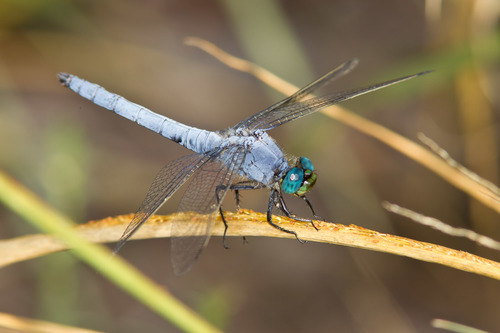
Western Pondhawk
Erythemis collocata
The Western Pondhawk is the 'blue bomber' of the garden, a fierce and beautiful aerial acrobat that provides natural pest control. Whether it's the powdery blue of the male or the neon green of the female, these dragonflies are a highlight of any backyard pond.
Quick Identification
Size
Length: 38–47 mm (1.5–1.9 in); Wingspan: 60–75 mm (2.4–3.0 in)
Colors
Mature males are powdery sky-blue with a distinctive green face. Females and juveniles are bright emerald green with black square-shaped spots along the abdomen.
Key Features
- Bright lime-green face on both sexes
- Mature males have a uniform powdery blue body
- Females show a 'checkerboard' pattern of green and black on the abdomen
- Low-flying, aggressive perching behavior
- Clear wings with small, pale spots at the base
When You’ll See Them
Behavior
The Western Pondhawk is one of the most assertive and territorial dragonflies in the western United States. Known for their 'perch and pounce' hunting strategy, they spend much of their time guarding a specific lookout point. From these low-lying perches, they launch high-speed aerial interceptions, often returning to the exact same spot to devour their prey. Males are particularly combative, frequently engaging in mid-air dogfights with rivals to defend their preferred shoreline territory.
Unlike many other dragonfly species that spend their time high in the air or tucked away in trees, the Western Pondhawk is a ground-dweller. It is commonly seen basking on flat stones, garden mulch, or low-hanging leaves. They are remarkably efficient hunters and are considered a biological control for garden pests, as they can consume their own body weight in insects every day. While they are fearless predators in the insect world, they are completely harmless to humans and often allow observers to get quite close before darting away.
EverydayEarth exclusive
Camera Tips
To capture high-quality footage of a Western Pondhawk, you must understand their perching habits. Unlike dragonflies that hover high, pondhawks prefer to stay low—usually between ground level and two feet high. Position your camera near the edge of a pond or a sunny garden bed. Look for 'sentinel spots' like the tip of a tall grass blade, a protruding stick, or a flat, sun-warmed rock. If you see a dragonfly returning to the same spot repeatedly, that is the perfect place to aim your camera.
Focus and depth of field are your biggest challenges with such small subjects. Set your camera for a close-range focus (1-3 feet) and use a high frame rate or 'action mode' to freeze their lightning-fast takeoffs. Because they are cold-blooded, they are most active in direct sunlight. Position your camera so the sun is behind the lens or to the side; this will illuminate the 'pruinescence' (the dusty blue wax) on the males and the vibrant neon green of the females, making them pop against the background.
You can effectively 'bait' a Western Pondhawk into your camera's field of view by providing the ideal perching architecture. Placing a few bamboo garden stakes or flat, light-colored stones in a sunny, wind-protected area near water will almost certainly attract a resident male looking for a territory to defend. Avoid placing cameras in heavily shaded areas, as these dragonflies require the sun's heat to stay active and will rarely land in the dark.
In terms of timing, the best 'action' happens during the hottest part of the day. For backyard observers, mid-summer is the golden window. Ensure your camera is set to trigger on small movements, as the AI might sometimes mistake a dragonfly for a falling leaf unless the sensitivity is calibrated correctly. Using a macro-enabled trail camera can reveal the incredible details of their compound eyes and the intricate veining in their wings.
Similar Species
Species that look similar or are commonly confused with Western Pondhawk.
Eastern Pondhawk
Virtually identical in appearance but found primarily east of the Great Plains; the two species rarely overlap geographically.
Blue Dasher
Smaller with a distinct black tip on the tail and striped markings on the sides of the thorax, unlike the solid blue pondhawk.
Western Forktail
A damselfly, which is much thinner and smaller, resting with its wings folded over its back rather than spread out to the sides.
Frequently Asked Questions
Record Western Pondhawk at your habitat
Connect a camera to start building your own species record — AI identifies every visitor automatically.