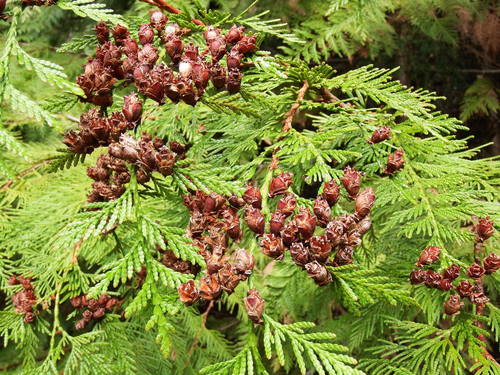
western redcedar
Thuja plicata
Known as the 'Giant of the Woods,' the western redcedar is a majestic evergreen that provides a sanctuary for wildlife and a sense of ancient history to any landscape.
Quick Identification
Size
Typically 45-70 m (150-230 ft) tall with a trunk diameter of 2-7 m (7-23 ft)
Colors
Deep glossy green foliage with white 'butterfly' markings on the underside; reddish-brown to silver-grey fibrous bark
Key Features
- Scale-like leaves arranged in flat, fern-like sprays
- Small, upright cones that resemble tiny wooden rosebuds
- Reddish-brown bark that peels in long, vertical stringy strips
- Distinctive 'J-shape' to the lower branches that swoop upward
When You’ll See Them
Behavior
The western redcedar is often referred to as the 'Tree of Life' due to its immense ecological and cultural importance. As a climax species, it is remarkably shade-tolerant, capable of surviving in the dim understory of an old-growth forest for centuries while waiting for a gap in the canopy to open. It is a slow-growing but incredibly long-lived giant, with many specimens surpassing the 1,000-year mark. Its wood contains natural fungicidal compounds (thujaplicins), which prevent rot and allow the tree to remain standing even after significant internal damage.
In the backyard ecosystem, the western redcedar acts as a silent guardian. Its dense, evergreen canopy provides a vital microclimate, offering cool shade in the summer and a thermal buffer during freezing winter nights. It interacts with the environment by enriching the soil with its shed needles and providing a structural foundation for complex webs of moss, lichens, and fungi. For humans, it is a majestic ornamental that demands space but rewards the owner with a year-round privacy screen and a soothing, aromatic scent.
EverydayEarth exclusive
Camera Tips
To capture the true essence of a western redcedar on a trail camera, you must think about scale and texture rather than movement. If your goal is to photograph the tree itself, place your camera at a low angle—about 1 to 2 feet off the ground—and tilt it upward at a 45-degree angle. This 'worm's eye view' emphasizes the massive, fluted trunk and the dramatic upward sweep of the branches. Because the bark has a beautiful, fibrous texture, avoid using a direct flash at night which can wash out the details; instead, rely on the soft, natural light of the 'blue hour' just before sunrise.
Western redcedars are wildlife magnets, making them the perfect 'stage' for your camera setup. Mounting a camera directly onto the trunk of a large redcedar facing a nearby clearing is a classic strategy, but for more unique shots, try mounting your camera on a branch or post facing the tree's base. Many mammals, including black bears and bobcats, use the base of large cedars as marking posts or sheltered resting spots. If your camera has a high-trigger sensitivity, aim it at the lower 'J-shaped' branches where birds like Varied Thrushes and Pacific Wrens often forage for insects hidden in the foliage.
For the most stunning visual results, set your camera to a time-lapse mode during the winter months. Western redcedars look spectacular when draped in snow, and a time-lapse can capture the tree’s flexibility as the branches bow under the weight and spring back up. If you are interested in the tree's reproductive cycle, use a macro-lens attachment or a close-up setting in early spring to capture the tiny, rosebud-like cones as they develop. Ensure your camera is set to its highest resolution (20MP or higher) to capture the intricate white 'butterfly' patterns on the underside of the leaves, which are a key identification feature.
Similar Species
Species that look similar or are commonly confused with western redcedar.
Frequently Asked Questions
Record western redcedar at your habitat
Connect a camera to start building your own species record — AI identifies every visitor automatically.