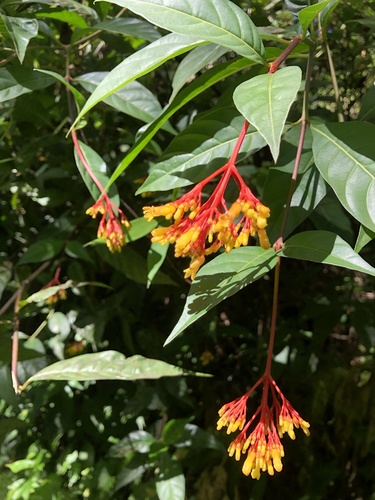
Yellow Cedar
Palicourea croceoides
A vibrant tropical shrub famous for its fiery red stems and golden tubular blooms, the Yellow Cedar is the ultimate hummingbird magnet for your backyard.
Quick Identification
Size
Shrub reaching 1-3 meters (3-10 feet) in height with a spread of 1-2 meters (3-6 feet).
Colors
Green glossy leaves; flower stalks (pedicels) are vibrant red or burnt orange; flowers are bright yellow to orange-yellow.
Key Features
- Bright red or orange branching flower stalks (rachis)
- Tubular yellow flowers roughly 1 inch long
- Opposite, elliptical leaves with prominent veins
- Small, round berries that turn from green to blue-black
- Evergreen, bushy growth habit
When You’ll See Them
Behavior
While the Yellow Cedar (Palicourea croceoides) is a plant, its "behavior" in a backyard setting is defined by its role as a high-energy hub for wildlife. It is a prolific bloomer, often producing its striking red and yellow inflorescences year-round in tropical and subtropical climates. This constant supply of nectar makes it a territorial centerpiece for hummingbirds, who will aggressively defend a large Yellow Cedar bush from rivals.
In the ecosystem of a backyard, this species acts as a bridge between the botanical and animal worlds. It doesn't just sit still; it responds to sunlight with rapid growth and produces berries that attract a variety of small fruit-eating birds and insects once the flowering cycle is complete. For humans, it is a low-maintenance but high-reward shrub that brings constant movement to the camera's field of view.
EverydayEarth exclusive
Camera Tips
To capture the best footage of the visitors attracted to your Yellow Cedar, position your camera on a tripod or mounting pole roughly 3 to 4 feet off the ground. Because the flowers are tubular and concentrated on the outer edges of the shrub, you want the camera to be level with the most active blooms. Aim for a distance of 2 to 5 feet depending on your camera’s focal minimum; this ensures that when a hummingbird hovers to feed, it fills a significant portion of the frame.
Since the primary visitors to this species are fast-moving hummingbirds and butterflies, camera settings are crucial. Use a high-speed trigger setting and, if your camera allows, a high frame rate (60fps or higher) for video to capture the wing blurred motion. For still photos, a fast shutter speed is necessary to freeze the action. If your camera has a 'Burst Mode' or 'Multi-shot' feature, enable it to catch the precise second a bird’s beak enters the yellow flower tube.
Lighting is another vital factor. Position the camera so the sun is behind it or at a 45-degree angle to the side. This illuminates the brilliant red stalks and yellow petals without silhouetting the visiting birds. Avoid placing the camera inside the foliage, as the wind-blown leaves of the Yellow Cedar can cause constant false triggers. Instead, create a clear line of sight to a specific 'cluster' of flowers and use zone-shielding in your app settings to ignore the moving branches in the background.
In the late afternoon, the berries (if present) become the main attraction. You may want to lower your camera slightly to capture ground-dwelling birds or smaller songbirds that perch on the lower branches to pluck the dark fruit. If you are using an AI-powered camera, the vibrant colors of the Palicourea croceoides provide an excellent high-contrast backdrop that helps the AI distinguish the shape and movement of wildlife more accurately.
Similar Species
Species that look similar or are commonly confused with Yellow Cedar.
Frequently Asked Questions
Record Yellow Cedar at your habitat
Connect a camera to start building your own species record — AI identifies every visitor automatically.