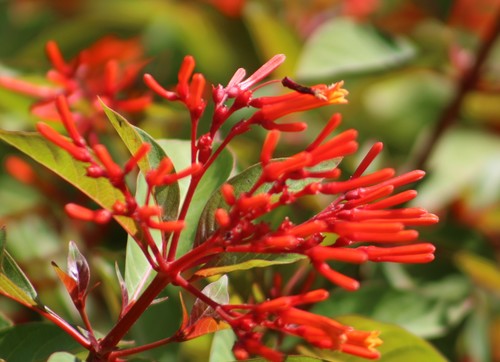
Firebush
Hamelia patens
The ultimate 'living bird feeder,' Firebush is a vibrant tropical shrub that provides a constant supply of nectar and berries. Its fiery orange blooms are a beacon for hummingbirds, making it the centerpiece of any wildlife-friendly backyard.
Quick Identification
Size
A woody shrub typically reaching 1.8–4.5 meters (6–15 feet) in height with a spread of 1.5–2.5 meters (5–8 feet).
Colors
Brilliant orange-red tubular flowers; dark green leaves with reddish-purple veins and stems; berries that transition from green to yellow, red, and finally glossy black.
Key Features
- Tubular, non-fragrant flowers in bright orange-red shades
- Leaves arranged in whorls of 3 to 7 at each node
- Small, fleshy berries that ripen to a deep black
- Fast-growing, multi-stemmed evergreen structure
When You’ll See Them
Behavior
While Firebush is a plant, its 'behavior' in a backyard ecosystem is that of a central hub for activity. It is a prolific bloomer, often producing clusters of nectar-rich flowers from late spring through the first frost, or year-round in frost-free climates. It acts as a primary energy source for migrating hummingbirds and a host of butterflies, including the Zebra Longwing and Gulf Fritillary. Its growth habit is vigorous, often bouncing back quickly even after a hard freeze in its northern range.
Beyond its flowers, the Firebush serves a secondary role as a critical food source for songbirds once its berries ripen. Unlike many shrubs that fruit all at once, the Firebush often displays flowers and berries in various stages of ripeness simultaneously. This creates a reliable, long-term feeding station that keeps wildlife returning to the same spot daily, making it one of the most predictable locations for backyard wildlife observation.
EverydayEarth exclusive
Camera Tips
Because Firebush is a stationary target that attracts fast-moving subjects, your camera strategy should focus on 'focal hotspots.' Identify a specific cluster of open, tubular flowers that receive good morning sunlight. Mount your camera on a stake or nearby fence post approximately 3 to 5 feet from the plant. Aim for a slightly side-on angle rather than top-down; this allows you to capture the long tongues of butterflies and the hovering profile of hummingbirds as they probe the blooms.
For AI-powered cameras, use a high-sensitivity trigger setting. Hummingbirds move with incredible speed, so if your camera allows for shutter speed adjustments, aim for 1/1000s or faster to freeze wing motion. If you are using a trail camera with video capabilities, set it to record 10-15 second clips. The movement of a Firebush in the wind can sometimes cause false triggers, so try to shield the plant from heavy gusts or adjust your PIR (Passive Infrared) sensor sensitivity to a medium level to focus on the heat signatures of birds and large insects.
Don't just focus on the flowers; the ripening berries are a magnet for Catbirds, Mockingbirds, and Cardinals. Position a second camera lower down, aimed at the interior branches where the berries are most dense. Since these birds are more cautious, ensure your camera is well-camouflaged within the foliage. Late afternoon light often hits the red stems and veins of the Firebush beautifully, providing a natural 'golden hour' glow that makes for stunning, high-contrast photos.
Lastly, consider the season. During peak migration (Spring and Fall), keep your camera's batteries fresh and storage clear, as a single Firebush can attract dozens of visitors in a single hour. If you are in a drought-prone area, lightly misting the leaves in the morning can create attractive water droplets that entice even more birds to visit for a quick drink or leaf-bath, providing unique action shots for your collection.
Similar Species
Species that look similar or are commonly confused with Firebush.
Frequently Asked Questions
Record Firebush at your habitat
Connect a camera to start building your own species record — AI identifies every visitor automatically.