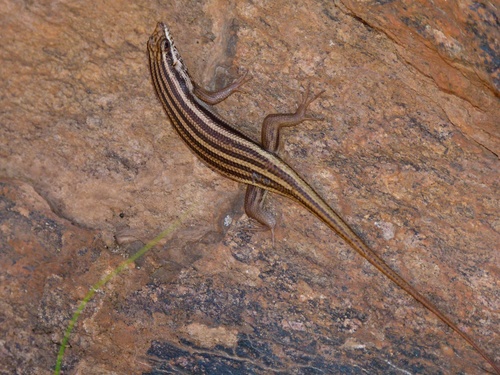
Western Rock Skink
Trachylepis sulcata
A sleek master of the African stone, the Western Rock Skink is a stripey, sun-loving reptile that brings life to rocky outcrops and garden walls alike.
Quick Identification
Size
Total length typically ranges from 15 to 20 cm (6 to 8 inches), with the tail making up a significant portion of that length.
Colors
Dark brown to blackish background with three distinct yellowish or cream longitudinal stripes running down the back; some individuals exhibit a copper or bronze sheen on the tail.
Key Features
- Distinct light-colored longitudinal stripes
- Smooth, glossy scales that overlap tightly
- Flattened body and head profile for rock crevice navigation
- Long, tapering tail often twice the body length
When You’ll See Them
Geographic range
Where Does the Western Rock Skink Live?
Native to the southern and western regions of the African continent, the Western Rock Skink is most commonly encountered across the rugged landscapes of South Africa, Namibia, and southern Angola. It thrives in arid and semi-arid environments where rocky terrain provides both thermal regulation and protection from predators. While its heartland is the Greater Cape Floristic Region and the Namibian escarpment, it has adapted well to human-modified landscapes like stone-walled gardens and farmsteads.
Basemap © OpenStreetMap contributors
Behavior
The Western Rock Skink is a diurnal reptile that spends a significant portion of its day basking on sun-warmed rocks. It is highly agile and alert, possessing a sleek, flattened body that allows it to vanish into incredibly narrow rock fissures at the slightest hint of danger. They are territorial but can often be found in loose colonies where rock outcrops provide ample hiding spots and sunning ledges.
Unlike many other skinks that forage in leaf litter, the Western Rock Skink is a visible climber. It is frequently seen scurrying vertically up boulders or stone walls. While they are naturally wary of humans, they can become somewhat accustomed to people in suburban garden settings, provided they have a quick escape route nearby. They are primarily solitary hunters, patrolling their rocky domain for small invertebrates.
EverydayEarth exclusive
Camera Tips
To capture high-quality footage of a Western Rock Skink, identify a 'sentinel rock'—a flat, prominent stone that receives early morning sun. These skinks are creatures of habit and will return to the same basking spot daily to regulate their body temperature. Position your camera just 12-18 inches away from the rock, angled slightly downward. Using a macro lens or a camera with a short focal distance is essential, as these reptiles are small and detail-oriented.
Because skinks move with sudden, jerky bursts of speed, set your AI camera to its highest trigger sensitivity and opt for video mode rather than still photos. A high frame rate (60fps or higher) will help you capture the flickering of their tongue and their rapid movements without motion blur. Avoid placing the camera where it will cast a shadow over the basking spot, as this will discourage the skink from appearing.
While they are not easily 'baited' like mammals, you can encourage them to stay in frame longer by ensuring the area has natural cover nearby. If you are using a trail camera in a backyard setting, place it near a rock pile or a stone retaining wall. The best time for recording is during the mid-morning when they are most active but still relatively still while warming up. During the heat of the midday sun, they often retreat into the shade of crevices, making them harder to film.
Similar Species
Species that look similar or are commonly confused with Western Rock Skink.
Frequently Asked Questions
Record Western Rock Skink at your habitat
Connect a camera to start building your own species record — AI identifies every visitor automatically.