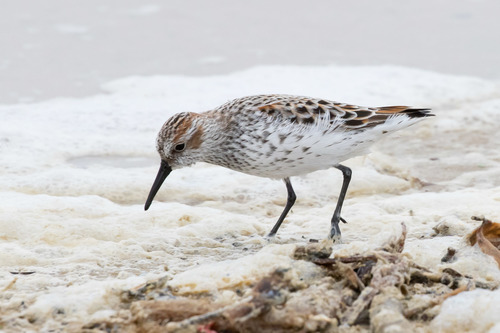
Western Sandpiper
Calidris mauri
A tiny but mighty traveler, the Western Sandpiper is a master of the mudflats, using its specialized bill like a precision tool. These social shorebirds transform coastal landscapes into a whirlwind of activity during their epic seasonal migrations.
Quick Identification
Size
Length: 14–17 cm (5.5–6.7 in); Wingspan: 28–37 cm (11–14.5 in); Weight: 22–35 g (0.8–1.2 oz)
Colors
Upperparts are grayish-brown in winter; breeding plumage features bright rufous (reddish-brown) on the crown and back. Underparts are white with fine, dark chevron streaks on the breast and flanks.
Key Features
- Relatively long bill with a subtle downward droop at the tip
- Solid black legs and feet
- Rufous coloring on the head and scapulars during breeding
- Small, tapered body with a fine, pointed tail
When You’ll See Them
Behavior
Western Sandpipers are the quintessential "sewing machines" of the shoreline. They move with incredible speed, rapidly probing their bills into the mud to find food. Unlike some more solitary shorebirds, the Western Sandpiper is highly gregarious, often found in massive, shimmering flocks that move in perfect synchronization. Watching a group of several thousand take flight to evade a predator is one of nature's most impressive aerial displays.
While they are focused and energetic foragers, they are generally peaceful among their own kind during migration. On their nesting grounds in the Arctic, males perform flight displays to defend territories, but for most backyard and coastal observers, they appear as busy, social travelers. They are highly dependent on the tidal cycle, resting in tight groups during high tide and feeding frantically as the water recedes.
EverydayEarth exclusive
Camera Tips
Capturing high-quality footage of Western Sandpipers requires a ground-level approach. Because these birds are only a few inches tall, a standard trail camera mounted on a post will miss the intimacy of their behavior. Instead, use a low-profile ground mount or a weighted beanbag to place the camera just 4 to 6 inches above the mud or sand. Angle the camera slightly upward or keep it level with the horizon to capture the 'eye-to-eye' perspective that makes for professional-looking wildlife photography.
Timing is everything with this species. Rather than relying on a 24-hour schedule, sync your camera checks with local tide charts. The 'sweet spot' for activity is usually the two-hour window on either side of high tide. As the water rises, it pushes the birds toward the upper edge of the beach or mudflat where your camera is positioned. If you are near a coastal area, look for 'wrack lines'—areas where seaweed and debris wash up—as these are natural magnets for the invertebrates the sandpipers hunt.
Because Western Sandpipers move their heads and bills with rapid-fire speed, traditional motion triggers can sometimes result in blurry images. If your camera supports it, use the 'High Speed' or 'Burst' mode to capture several frames in a row. For video, a high frame rate (60fps or higher) is recommended so you can slow down the footage to see the incredible mechanics of their feeding. Avoid using flash at night as these birds are rarely active then; instead, focus on the golden hour light of early morning or late afternoon for the best color saturation on their rufous feathers.
In a backyard setting near water, you can encourage them to stay in front of the lens by creating a shallow 'mud zone.' A wide, flat tray filled with wet, silty mud and a bit of brackish water can act as a natural lure. However, the most effective 'bait' is simply locating the exact spot on the mudflat where they consistently congregate. Look for their tiny, star-shaped footprints and place your camera facing away from the sun to avoid harsh silhouettes.
Similar Species
Species that look similar or are commonly confused with Western Sandpiper.
Frequently Asked Questions
Record Western Sandpiper at your habitat
Connect a camera to start building your own species record — AI identifies every visitor automatically.