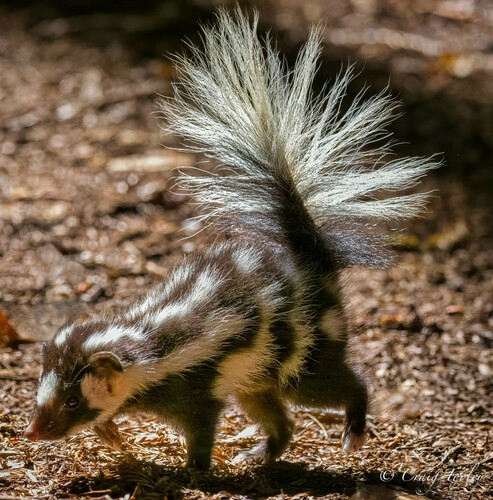
Western Spotted Skunk
Spilogale gracilis
The Western Spotted Skunk is the acrobat of the skunk family, known for its stunning white-spotted coat and its unique ability to perform handstands when threatened. Smaller and more elusive than the common striped skunk, this nocturnal wanderer is a fascinating addition to any backyard camera roll.
Quick Identification
Size
Total length: 9-14 inches (23-37 cm); Weight: 0.5-2 lbs (200-900g)
Colors
Jet black fur with complex white spots and broken horizontal stripes; notable white spot on the forehead and a white-tipped tail.
Key Features
- Slender, squirrel-like build significantly smaller than a striped skunk
- Pattern of spots and broken stripes rather than continuous lines
- White-tipped, bushy tail
- Characteristic 'handstand' defensive posture when threatened
When You’ll See Them
Behavior
The Western Spotted Skunk is far more agile and energetic than its larger, slow-moving striped relatives. These small carnivores are excellent climbers and are often found scaling trees or rocky outcroppings to find food or escape predators. Unlike most skunks, they are incredibly quick and can be seen darting between cover with a playful, almost weasel-like gait.
While they possess the same famous scent glands as other skunks, they are unique in their warning display. Before spraying, a Western Spotted Skunk will often perform a dramatic 'handstand,' balancing on its front paws and waving its tail to appear larger and more intimidating. They are generally solitary and shy, making them a prized capture for any backyard wildlife enthusiast.
EverydayEarth exclusive
Camera Tips
To capture the Western Spotted Skunk, camera placement is everything. Because these animals are much smaller and lower to the ground than striped skunks, you should mount your camera very low—typically only 6 to 12 inches off the ground. Aiming the camera along 'edge' habitats, such as the base of a stone wall, a woodpile, or a dense hedge line, is your best bet, as they rarely cross open lawns and prefer to stay near protective cover.
We highly recommend using video mode rather than still photos for this species. Their movements are quick and erratic, and a still image often captures only a blur of black and white. More importantly, video is the only way to catch their incredible defensive 'handstand' or their agile climbing behavior. Set your PIR (motion sensor) to high sensitivity and reduce the trigger interval to the shortest possible setting to ensure you don't miss them as they dart through the frame.
Scent is the most effective way to draw a Western Spotted Skunk into your camera’s field of view. A small amount of oily bait, such as canned sardines or wet cat food, placed inside a perforated container (to prevent them from dragging it away) will often keep them in front of the lens for several minutes. If you prefer not to use food, a cotton ball soaked in a commercial predator lure or even some peanut butter can pique their curiosity.
Seasonally, you will have the most success during the drier months when they are actively hunting for insects and small mammals. During the winter, they may share communal dens to stay warm, so if you find a suspected den site under a shed or rock pile, placing a camera nearby can reveal multiple individuals using the same entrance during the early evening hours.
Similar Species
Species that look similar or are commonly confused with Western Spotted Skunk.
Frequently Asked Questions
Record Western Spotted Skunk at your habitat
Connect a camera to start building your own species record — AI identifies every visitor automatically.