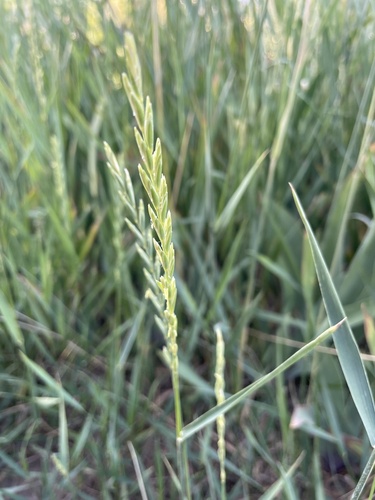
Western Wheatgrass
Elymus smithii
The backbone of the American prairie, Western Wheatgrass is a resilient native known for its striking blue-green hue and ability to form a protective carpet for backyard wildlife.
Quick Identification
Size
Stems typically reach 1-3 feet (30-90 cm) in height; leaf blades are 2-10 inches (5-25 cm) long.
Colors
Distinctive glaucous blue-green foliage with a waxy coating; turns to a golden-straw color during winter or summer dormancy.
Key Features
- Stiff, upright stems with a waxy blue-gray tint
- Creeping rhizomes that form a dense, sod-like ground cover
- Seed heads are 2-6 inches long, resembling narrow heads of wheat
- Rough-textured leaf blades that often roll inward when dry
When You’ll See Them
Behavior
Western Wheatgrass is a hardy, cool-season perennial grass known for its "sod-forming" growth habit. Unlike bunchgrasses that grow in isolated tufts, this species uses an extensive system of underground runners called rhizomes to spread horizontally. This creates a resilient, carpet-like mat that is exceptionally good at stabilizing soil and resisting erosion, even in high-traffic areas or windswept prairies.
Ecologically, it acts as a "foundation species." It begins growing early in the spring while many other plants are still dormant, providing vital early-season forage and nesting cover. During the peak heat of summer, the plant may enter a brief period of dormancy to conserve moisture, only to green up again when cooler autumn temperatures and rains arrive. Its stiff stems allow it to remain upright even under light snow, providing year-round structure to the backyard landscape.
EverydayEarth exclusive
Camera Tips
Capturing Western Wheatgrass on a trail camera requires focusing on its role as habitat. Because it is a "sod-former," it creates excellent low-level cover for small wildlife. Position your camera on a ground mount or a very short tripod, no more than 6 to 10 inches off the ground. This "mouse-eye view" allows you to see the intricate blue-green stalks and provides a perfect frame for capturing small mammals like voles, rabbits, or ground-nesting birds that navigate through the grass.
To get the most aesthetic shots, utilize backlighting. Position your camera facing north or south so that the rising or setting sun hits the grass from the side or back. This makes the waxy, glaucous coating on the leaves shimmer and highlights the fine textures of the wheat-like seed heads. These golden-hour shots transform a simple patch of grass into a professional-looking wildlife backdrop.
If your camera has a time-lapse mode, use it! Western Wheatgrass shows incredible transformation over the seasons. Setting a time-lapse to take one photo every day at noon will allow you to create a stunning video of the grass emerging in the spring, blooming in early summer, and turning to gold in the autumn. This is a great way to document the "pulse" of your backyard ecosystem.
Be careful with motion sensor (PIR) settings. In high winds, the stiff stalks of Western Wheatgrass can sway enough to trigger some cameras, especially on hot days when the grass is warmer than the background. Set your sensitivity to 'Medium' and clear any stalks that are within two feet of the lens to prevent blurry "ghost" triggers. If you are specifically looking for birds, try to find a taller stalk that stands above the rest; songbirds often use these as lookout perches before descending to feed on the ground.
Similar Species
Species that look similar or are commonly confused with Western Wheatgrass.
Frequently Asked Questions
Record Western Wheatgrass at your habitat
Connect a camera to start building your own species record — AI identifies every visitor automatically.