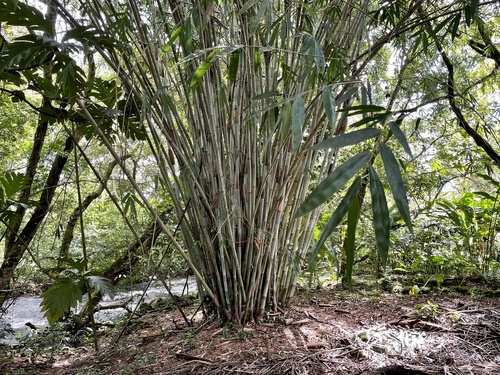
White Bamboo
Bambusa chungii
A striking architectural marvel, White Bamboo is famous for its ghostly blue-white culms that glow in the twilight. This non-invasive giant brings a touch of tropical elegance and rapid-growth drama to any backyard sanctuary.
Quick Identification
Size
Height: 30-40 feet (9-12 meters); Culm diameter: 2 inches (5 cm)
Colors
Powdery blue-white new culms maturing to pale green; dark green lance-shaped leaves
Key Features
- Distinctive white powdery 'bloom' on new culms
- Dense clumping, non-invasive growth habit
- Culms are nearly branchless on the bottom half
- Rapid vertical growth during summer months
When You’ll See Them
Behavior
As the plant matures, it naturally sheds its lower branches, which serves to highlight the stunning, ghost-like white culms. This creates a high canopy that provides excellent privacy while leaving the ground level open and airy. In the wild and in backyards, the dense top-foliage provides a safe haven for small birds and beneficial insects, while the canes themselves create a soothing rhythmic sound when they knock together in a breeze.
Unlike many other bamboo species that look messy, White Bamboo maintains a very 'clean' appearance. It is quite hardy once established, though it prefers to be sheltered from high-velocity winds which can rub the delicate white powder—the plant’s most famous feature—off of the canes.
EverydayEarth exclusive
Camera Tips
Lighting is the most critical factor when photographing this species. The white powdery bloom on the culms is highly reflective, making it glow during the 'golden hour' (the hour after sunrise and before sunset). If you are using a trail camera with an infrared (IR) flash at night, the reflective surface can sometimes cause 'white-out' on the image. To prevent this, angle your camera at a 45-degree diagonal to the grove rather than pointing it directly at the canes. This creates shadows that emphasize the roundness and texture of the bamboo.
Because White Bamboo creates a dense upper canopy, it acts as a high-rise apartment for backyard birds. Consider mounting a camera higher up—around 8-10 feet—pointed toward the mid-canopy where branches begin to emerge. You are likely to catch songbirds like finches, tits, and wrens using the bamboo as a staging area before they visit your bird feeders. Placing a water source near the base of the bamboo is another great way to lure wildlife into the frame, using the striking vertical white lines of the canes as a natural, artistic backdrop.
Keep in mind that bamboo can be a 'dusty' plant. The culm sheaths fall off as the plant grows, and a fine powder can sometimes coat your lens if the camera is placed too close. Check your camera lens every few days and give it a quick wipe with a microfiber cloth. Also, because these canes are tall and flexible, they may sway into your camera's field of view during a storm, potentially triggering hundreds of false motion events. Use a 'Zone' setting on your AI camera to focus only on the ground area if you want to avoid wind-triggered recordings while still catching animals passing through the grove.
Similar Species
Species that look similar or are commonly confused with White Bamboo.
Frequently Asked Questions
Record White Bamboo at your habitat
Connect a camera to start building your own species record — AI identifies every visitor automatically.