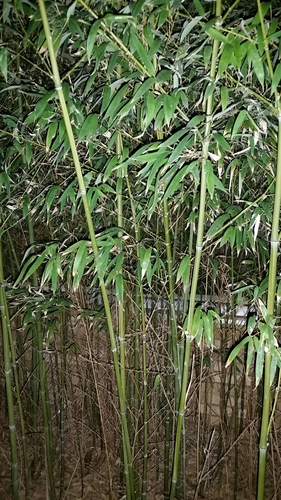
weaver's bamboo
Bambusa textilis
A masterpiece of natural architecture, weaver's bamboo is a graceful, non-invasive giant that provides the perfect living privacy screen. With its slender green culms and rustling canopy, it brings a touch of tropical serenity to any backyard.
Quick Identification
Size
Grows 6–10 meters (20–33 feet) tall with culms 3–5 cm (1.2–2 inches) in diameter.
Colors
Bright emerald green culms that develop a white, waxy 'bloom' when young; matures to a pale green or yellowish-tan.
Key Features
- Tight clumping growth habit (non-invasive)
- Slender, upright culms with thin walls
- Graceful, arching foliage at the top
- Noticeable white powder at nodes on new growth
When You’ll See Them
Behavior
Weaver's bamboo is a 'clumping' species, meaning it grows in a predictable, tight circle rather than sending out underground runners that invade the rest of your yard. This makes it a favorite for suburban gardeners looking for a natural privacy screen. It is remarkably fast-growing, especially during the humid summer months, when new shoots can emerge from the ground and reach their full height in just a few weeks.
In the backyard ecosystem, this bamboo acts as a vertical forest. Its dense canopy provides a safe haven for small songbirds and insects, while its root system helps stabilize soil. Unlike many other bamboos, weaver's bamboo is relatively quiet in the wind, producing a soft, rustling sound rather than the loud clacking of larger timber varieties. It interacts well with humans, as it is easy to prune and its thin-walled culms are historically used for weaving high-quality baskets and mats.
EverydayEarth exclusive
Camera Tips
To capture the true beauty of weaver's bamboo, placement is everything. Position your camera about 5 to 10 feet away from the base of the clump, aiming slightly upward at a 30-degree angle. This perspective captures both the strength of the vertical culms and the delicate, arching canopy. If you are tracking the growth of new shoots in the late summer, place the camera on a low tripod or mount it to a stake just 2 feet off the ground. These shoots can grow several inches a day, making them perfect subjects for time-lapse photography.
Because bamboo moves gracefully in the breeze, use a camera with a high frame rate or a 'fast' shutter speed setting to avoid motion blur on the leaves. If your camera has a time-lapse mode, set it to take one photo every 30 minutes during the summer shooting season. You will be amazed to see the 'dance' of the culms as they expand and reach for the light over the course of a week.
Lighting is your best friend with this species. Try to orient your camera so it is facing north or south; this allows the morning and evening sun to side-light the waxy green culms, highlighting the white 'bloom' at the nodes. Avoid placing the camera directly facing the sun, as the dense foliage can create high-contrast shadows that obscure the detail of the culms. For night shots, weaver's bamboo looks spectacular when illuminated by a low-power, warm-toned external LED light, which can help reveal the architectural structure of the plant against the dark night sky.
Similar Species
Species that look similar or are commonly confused with weaver's bamboo.
Frequently Asked Questions
Record weaver's bamboo at your habitat
Connect a camera to start building your own species record — AI identifies every visitor automatically.