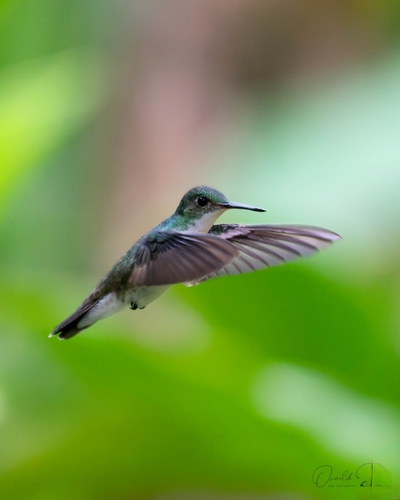
White-bellied Emerald
Chlorestes candida
A shimmering jewel of the Central American lowlands, the White-bellied Emerald is easily identified by its snowy white underside and metallic green coat. This adaptable hummingbird brings a splash of iridescent energy to tropical gardens and forest edges alike.
Quick Identification
Size
8-11 cm (3.1-4.3 in) in length; weight approximately 3.4-4.1 g (0.12-0.14 oz)
Colors
Metallic golden-green upperparts with a brilliant white throat, breast, and belly; tail is dull green to bronze; bill is black on top with a pinkish-flesh base on the lower mandible.
Key Features
- Stark white underparts from throat to vent
- Straight bill with a pale pinkish base on the lower mandible
- Metallic green or bronze-green upperparts
- Small, rounded bronze-green tail
- Lacks the blue or violet tones found on similar emerald species
When You’ll See Them
Geographic range
Where Does the White-bellied Emerald Live?
This stunning hummingbird is a native resident of Central America and the southern reaches of North America. Its core territory stretches from the Atlantic slope of southeastern Mexico through Belize, Guatemala, Honduras, and Nicaragua, with occasional sightings in Panama. Within this region, it is a lowland specialist, favoring humid environments where consistent moisture supports year-round blooming flora.
Basemap © OpenStreetMap contributors
Behavior
The White-bellied Emerald is a versatile and relatively adaptable hummingbird often found flitting through the mid-canopy and edges of humid forests. Unlike some of its more territorial relatives, this species is frequently observed foraging at a variety of flowering plants without being overly aggressive toward other nectar-feeders, though it will defend a particularly rich food source when necessary.
In backyard settings, they are known for their inquisitive nature, often hovering briefly to inspect new objects or people before returning to their feeding routine. They exhibit a characteristic 'trap-lining' behavior, where they follow a regular route between scattered flower clusters throughout the day, ensuring a steady intake of high-energy nectar to fuel their high-metabolism lifestyle.
EverydayEarth exclusive
Camera Tips
To capture the White-bellied Emerald on camera, positioning is everything. Focus your AI-powered camera on high-energy nectar sources like red or orange tubular flowers (such as Hibiscus, Heliconia, or Shrimp Plant). Because these birds move with incredible speed, set your camera at a height of 4 to 6 feet, angled slightly upward if the flowers are hanging, to capture the brilliant white of their bellies which distinguishes them from other emeralds.
Lighting is your best friend for iridescent plumage. Try to place your camera in a spot that receives bright, indirect morning sun. Direct noon sun can 'blow out' the white feathers and create harsh shadows, while deep shade will make their metallic green back look dull or black. A trigger speed of under 0.1 seconds is ideal for catching them in mid-hover; otherwise, you may just capture a green blur.
If using a hummingbird feeder to attract them, place the camera about 2 to 3 feet away from the feeder port. Use a 'perch' setup—place a small, thin branch about 12 inches from the feeder. White-bellied Emeralds often like to survey the area before feeding, and a pre-placed perch gives you a stable, non-moving subject for a much clearer portrait than a bird in flight. These birds are early risers, so ensure your camera is active and has fresh batteries before the first light of dawn.
Similar Species
Species that look similar or are commonly confused with White-bellied Emerald.
Azure-crowned Hummingbird
Distinguished by its vibrant blue crown and a more distinctly bicolored bill compared to the Emerald.
Cozumel Emerald
Found only on Cozumel Island; it has a shorter bill and the male has a more deeply forked tail.
Canivet's Emerald
Lacks the white belly, featuring green underparts and a much more deeply forked, dark tail.
Frequently Asked Questions
Record White-bellied Emerald at your habitat
Connect a camera to start building your own species record — AI identifies every visitor automatically.