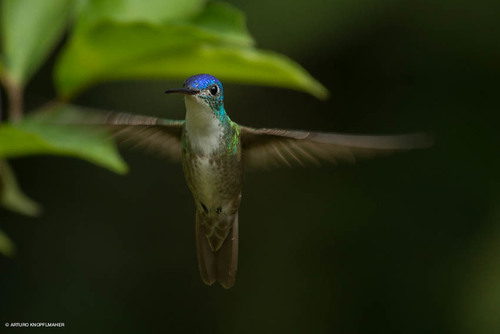
Azure-crowned Hummingbird
Saucerottia cyanocephala
With its shimmering violet-blue cap and snowy white breast, the Azure-crowned Hummingbird is a crown jewel of Central American gardens. This hardy 'emerald' is a frequent visitor to backyard feeders, bringing a dash of high-altitude brilliance to everyday birdwatching.
Quick Identification
Size
10-11 cm (3.9-4.3 in) in length; weighs 5.2-5.8 g
Colors
Brilliant azure-blue to violet crown, white throat and breast, bronze-green back and tail, black bill with a reddish base
Key Features
- Vivid azure-blue or violet cap
- Pristine white throat and breast
- Bronze-green upperparts and tail
- Blackish bill with a reddish/pinkish base on the lower mandible
- Medium-sized hummingbird, approx. 4 inches
When You’ll See Them
Geographic range
Where Does the Azure-crowned Hummingbird Live?
This stunning bird is a native of Central America and southern Mexico. Its core range extends from the highlands of eastern and southern Mexico through Guatemala, Belize, El Salvador, Honduras, and into northern Nicaragua. While it is primarily found in mountainous regions, it occasionally ventures into lower coastal slopes where suitable habitat exists.
Basemap © OpenStreetMap contributors
Behavior
The Azure-crowned Hummingbird is known for its bold and somewhat territorial nature. Unlike some more skittish species, it often frequents gardens and suburban areas where it can be seen defending a cluster of flowers or a feeder from other hummingbirds. It flies with the characteristic rapid wingbeats of the emerald tribe, often hovering with great precision before darting off to the next nectar source.
While mostly solitary in its foraging, it is highly observant of its surroundings. In backyards, it may become accustomed to human presence, especially if a reliable food source is provided. During the breeding season, males perform aerial displays to attract females, though they do not participate in nesting or raising the young, which is typical for hummingbirds.
EverydayEarth exclusive
Camera Tips
To capture the brilliant blue crown of this species, camera placement is critical. Set up your AI-powered camera near a nectar feeder or a high-traffic flowering plant like Salvia or Fuchsia. Since hummingbirds are fast, position the camera approximately 2 to 3 feet away from the target area to ensure the autofocus can keep up while still providing enough detail to see the iridescent feathers. Angle the camera slightly downward or at eye-level with the flowers to catch the light hitting the azure cap.
Lighting is your best friend when filming Azure-crowned Hummingbirds. These birds are most active in the early morning and late afternoon. Try to position your camera so the sun is behind you or at a 45-degree angle to the bird's path; this direct light is necessary to make the metallic blue of the crown 'pop' against the white throat. If your camera has a high-speed trigger or 'pre-roll' feature, enable it to catch the split-second arrivals and departures that standard motion sensors might miss.
For those using bait, a standard 4:1 water-to-sugar nectar ratio works wonders, but the Azure-crowned is particularly fond of red tubular flowers. If you can, place your camera near native flowering shrubs. In suburban settings, these birds are quite bold, so don't be afraid to mount the camera on a porch or deck railing. Ensure the background is relatively uncluttered so the AI can easily distinguish the bird from moving leaves, which helps in getting cleaner, more accurate captures.
Similar Species
Species that look similar or are commonly confused with Azure-crowned Hummingbird.
Berylline Hummingbird
Lacks the azure crown and has a much more uniform green and bronze underbelly compared to the white-chested Azure-crowned.
White-bellied Emerald
Features similar white underparts but lacks the distinctive iridescent blue crown of the Azure-crowned.
Violet-crowned Hummingbird
Has a similar crown but features a much brighter, snow-white throat and a distinctly red bill with a black tip.
Frequently Asked Questions
Record Azure-crowned Hummingbird at your habitat
Connect a camera to start building your own species record — AI identifies every visitor automatically.