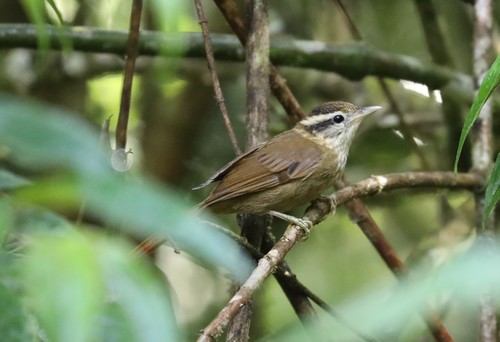
White-browed Foliage-gleaner
Anabacerthia amaurotis
A restless acrobat of the Atlantic Forest, the White-browed Foliage-gleaner is a master at finding life hidden in the leaf litter of the canopy.
Quick Identification
Size
16 cm (6.3 in) in length; weighs approximately 19–25 g (0.67–0.88 oz)
Colors
Dull olive-brown upperparts with a bright rufous tail and wings; distinctive creamy-white eyebrow; buffy-white throat
Key Features
- Bold white or creamy-white supercilium (eyebrow)
- Bright rufous tail and wing coverts
- Pale, buffy-colored throat
- Acrobatic foraging style, often hanging upside down
When You’ll See Them
Geographic range
Where Does the White-browed Foliage-gleaner Live?
This bird is a specialist of the South American Atlantic Forest biome. Its native range is concentrated in southeastern Brazil, stretching from the state of Espírito Santo south to Rio Grande do Sul. It is also found in the humid forests of northeastern Argentina, specifically in the Misiones province, and has been occasionally recorded in eastern Paraguay, though it remains rare there due to habitat fragmentation.
Basemap © OpenStreetMap contributors
Behavior
The White-browed Foliage-gleaner is an energetic and acrobatic member of the ovenbird family. It is famous among birdwatchers for its specialized foraging technique: it spends much of its day rummaging through clusters of dead leaves that have become trapped in vines or bromeliads. It uses its bill to probe and toss debris, searching for hidden insects and spiders, often performing impressive gymnastic feats like hanging completely upside down to reach a promising leaf curl.
Socially, this species is a frequent participant in mixed-species foraging flocks. It rarely travels alone, preferring the company of woodcreepers, antshrikes, and other foliage-gleaners. While it isn't particularly wary of humans, its preference for dense, tangled vegetation in the forest mid-story means it is often heard—making a sharp 'tsip' or 'che-che-che' call—before it is seen. It is a non-migratory bird, maintaining a stable territory throughout the year.
EverydayEarth exclusive
Camera Tips
Capturing the White-browed Foliage-gleaner requires placing your camera where the action is: the 'tangle' zones of the forest. These birds are attracted to vertical structures with plenty of debris. Look for a tree with heavy vine growth or a cluster of large bromeliads. Mount your camera at eye level (about 5-6 feet high) and angle it slightly toward a patch of suspended dead leaves, as this is where they spend the majority of their time foraging.
Because they are constantly moving and twitching their tails, set your camera to a fast trigger speed and utilize a 'burst' or 'multi-shot' mode. This increases your chances of getting a sharp image of their distinctive white eyebrow rather than a brown blur. If your camera allows for video, short 10-second clips are excellent for capturing their unique, jerky foraging movements and the way they manipulate leaves with their bills.
In a backyard setting near forest edges, you can attract them by maintaining a 'wild' corner with native shrubs and avoiding the removal of dead leaf litter from lower branches. While they don't visit traditional seed feeders, they are highly attracted to moving water. A solar-powered birdbath with a dripper or a small fountain placed near dense cover is the most effective way to lure them into a clear camera frame during the drier parts of the afternoon.
Similar Species
Species that look similar or are commonly confused with White-browed Foliage-gleaner.
Frequently Asked Questions
Record White-browed Foliage-gleaner at your habitat
Connect a camera to start building your own species record — AI identifies every visitor automatically.