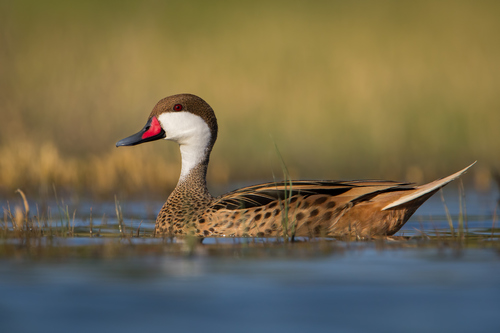
White-cheeked Pintail
Anas bahamensis
Elegant and unmistakable, the White-cheeked Pintail is a master of the brackish lagoon. With its striking white face and red-based bill, this tropical dabbler is a favorite for backyard birders near the coast.
Quick Identification
Size
Length: 38–51 cm (15–20 in); Wingspan: 60–75 cm (24–30 in); Weight: 400–700 g (0.9–1.5 lbs)
Colors
Mottled cinnamon-brown body with black spotting; striking white patches on the cheeks and throat; bluish-grey bill with a bright red base; yellowish-brown tail.
Key Features
- Prominent white cheeks and throat contrasting with dark crown
- Bluish bill with a vivid red triangular patch at the base
- Long, pointed yellowish-buff tail
- Brownish-cinnamon plumage with dark spotting
When You’ll See Them
Geographic range
Where Does the White-cheeked Pintail Live?
The White-cheeked Pintail is natively distributed across the Caribbean, the Galapagos Islands, and much of South America. Its core range includes the Bahamas, the Greater and Lesser Antilles, and coastal regions from Colombia and Venezuela down through Brazil to Argentina. While they are primarily tropical residents, occasional vagrants are spotted as far north as southern Florida, particularly in the Everglades and the Keys.
Basemap © OpenStreetMap contributors
Behavior
The White-cheeked Pintail is a gregarious dabbling duck, though it is notably more cautious and shy than many of its urban-dwelling relatives. It is typically seen in pairs or small family groups, though they may congregate in larger flocks where food is abundant. Unlike most duck species where the male is much flashier than the female, the White-cheeked Pintail is monochromatic; both sexes share the same beautiful white facial markings and red bill patches, though the male is usually slightly larger with a longer tail.
In the water, they are classic dabblers, tipping their bodies forward with their tails in the air to reach aquatic vegetation. They are strong flyers and are known to be quite active during the twilight hours. While they are generally quiet birds, the male occasionally emits a soft whistle, while the female gives a harsh, descending quack. In areas where they coexist with humans, they can become somewhat accustomed to activity but rarely become 'tame' like Mallards.
EverydayEarth exclusive
Camera Tips
To capture the best footage of a White-cheeked Pintail, positioning is everything. These ducks spend most of their time at the water's edge or in shallow flats. Set your camera on a low-profile mount or a short tripod just inches above the water line or muddy bank. This 'water-level' perspective provides an intimate view of their behavior and makes the distinctive red patch on their bill stand out against the water. Aim for a spot where the shoreline curves, as ducks often follow the contour of the bank while foraging.
Since these birds are most active during the 'golden hours' of dawn and dusk, ensure your camera has a high-quality sensor capable of handling low-light conditions without excessive grain. If your camera allows for adjustable trigger speeds, set it to the fastest possible setting. Pintails are quick to tip up and down while dabbling, and a slow trigger will often result in a shot of just a tail or a splash. A video duration of 15-20 seconds is usually ideal to capture the full sequence of a dabble and the subsequent feather-shake.
If you are trying to attract them to a specific backyard lagoon or pond, provide natural cover like tall grasses or mangrove-style vegetation near the camera site. They feel much more comfortable approaching an area where they can quickly retreat into cover. While we don't recommend artificial lures for wild ducks, maintaining a healthy native aquatic plant population will naturally draw them in. Ensure the camera is pointed away from the direct rising or setting sun to avoid lens flare, which can wash out the subtle cinnamon tones of their plumage.
Similar Species
Species that look similar or are commonly confused with White-cheeked Pintail.
Frequently Asked Questions
Record White-cheeked Pintail at your habitat
Connect a camera to start building your own species record — AI identifies every visitor automatically.