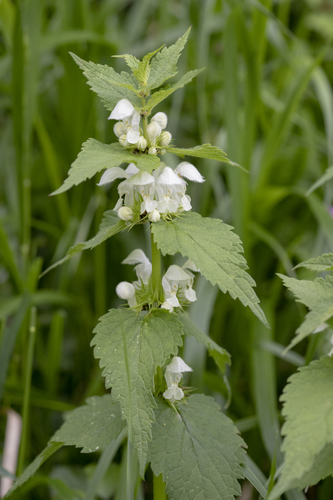
White deadnettle
Lamium album
The 'gentle cousin' of the stinging nettle, White Dead-nettle is a beautiful, sting-free wildflower that provides a vital sanctuary for bumblebees from early spring through late autumn.
Quick Identification
Size
Stands 20–100 cm (8–40 inches) tall; flower whorls are roughly 2–3 cm (1 inch) wide.
Colors
Bright white hooded flowers with greenish-yellow centers; dark green leaves sometimes featuring a pale silver stripe or variegation; square green stems.
Key Features
- Square stems characteristic of the mint family
- Whorls of 6-15 white, hooded flowers arranged around the stem
- Opposite, heart-shaped leaves with deeply serrated edges
- Completely lacks stinging hairs and is soft to the touch
- Flowers feature a prominent 'hood' and a smaller lower lip
When You’ll See Them
Behavior
White dead-nettle is a hardy perennial that is often mistaken for the common stinging nettle until it begins to bloom. Unlike its namesake, it is completely harmless and does not possess stinging hairs, earning it the 'dead' moniker. It is a highly resilient plant that spreads primarily through underground runners (rhizomes), often forming dense, lush carpets in shady garden corners or along hedgerows.
This species is a vital early-season resource for wildlife. Because it begins flowering as early as March and can continue through to the first frosts of winter, it serves as a primary nectar source for long-tongued insects. It has a particularly symbiotic relationship with bumblebees, which are one of the few insects strong enough to push open the hooded petals to reach the deep nectar reserves inside.
EverydayEarth exclusive
Camera Tips
Because white dead-nettle is stationary, it provides an excellent opportunity to practice macro photography and time-lapse sequences. To capture the best detail of the hooded flowers, position your camera on a low-profile tripod or a ground mount. Aim for a lens height of about 30–50 cm (12–20 inches) to look directly into the whorls of flowers. This 'insect-eye' perspective makes for a much more compelling shot than looking down from above.
For those using AI-triggered cameras like the ones we feature at EverydayEarth, focus your lens on a particularly healthy cluster of flowers in a sun-dappled area. These plants are 'pollinator magnets.' By setting your camera to a high-trigger sensitivity or short interval time-lapse, you are almost guaranteed to capture stunning footage of Garden Bumblebees and Carder Bees. These insects often spend several seconds at each flower, giving your camera's autofocus plenty of time to lock on.
Since white dead-nettle thrives in slightly shaded areas, lighting can be a challenge. If your camera setup allows for it, try to position the plant so it is backlit by the morning sun. The fine, soft hairs on the leaves and the translucent white petals will 'glow' against a darker background, highlighting the plant's delicate structure. Avoid using a direct flash, which can wash out the subtle textures of the white petals.
Don't forget the long game! Because this plant grows and flowers over such a long period, it is a perfect candidate for a season-long time-lapse. Set your camera to take one photo every 6 hours from the same position. Over a few months, you'll see the fascinating way the square stems elongate and the flower whorls develop sequentially from the bottom of the plant to the top.
Similar Species
Species that look similar or are commonly confused with White deadnettle.
Frequently Asked Questions
Record White deadnettle at your habitat
Connect a camera to start building your own species record — AI identifies every visitor automatically.