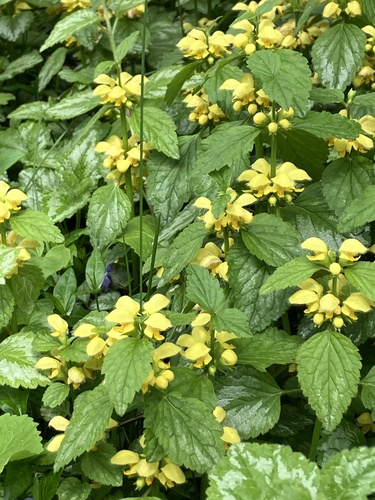
yellow archangel
Lamium galeobdolon
A luminous addition to the forest floor, the yellow archangel is famous for its metallic silver leaves and brilliant golden blooms that brighten even the deepest shade.
Quick Identification
Size
Stems reach 30–60 cm (12–24 in) in height; spread is indefinite as it forms a dense mat.
Colors
Bright yellow flowers; dark green leaves with striking silver-white metallic patches or variegation.
Key Features
- Distinctive square-shaped stems common to the mint family
- Vivid yellow hooded flowers arranged in circular whorls
- Heart-shaped leaves with silver marbling and serrated edges
- Prostrate growth habit that forms a thick, carpet-like groundcover.
When You’ll See Them
Behavior
Yellow archangel is a hardy, shade-loving perennial that behaves as an aggressive groundcover. It spreads primarily through stolons—horizontal runners that creep along the soil surface and take root at various nodes. This allows a single plant to quickly colonize large areas, creating a lush, dense carpet that can outcompete other low-growing vegetation. During its flowering peak in late spring, it sends up upright stems that hold its signature golden blossoms high enough to attract passing insects.
While it is a popular ornamental plant in shaded garden borders, its vigorous growth often leads it to escape into nearby woodlands. In these natural settings, it can be quite assertive, forming monocultures that displace native spring ephemerals. Despite its competitive nature, it is a valuable nectar source for early-season pollinators, particularly bumblebees, who are strong enough to push into the hooded flowers. It interacts with humans mostly as a decorative landscape choice, though conservationists often monitor it closely for its invasive potential.
EverydayEarth exclusive
Camera Tips
Capturing the yellow archangel requires a low-profile approach since the plant stays close to the ground. To get the best results, mount your camera on a ground-level spike or a very short tripod. Aim the lens at a 45-degree angle toward a healthy cluster of flowers. Because this plant thrives in the shade, lighting can be tricky; try to position the camera where it can catch 'dappled' sunlight filtering through the trees, which will make the silver markings on the leaves pop and appear almost metallic on screen.
For those using AI-powered cameras with motion detection, the yellow archangel is an excellent 'stage' for capturing pollinator activity. Focus your camera on a specific whorl of flowers and set the sensitivity high. You are likely to capture spectacular close-ups of bumblebees and hoverflies. If your camera supports time-lapse mode, set it to take a photo every hour during the month of May. When played back, you will see the fascinating way the vertical flowering stalks emerge from the flat green mat of leaves and the flowers open in stages from bottom to top.
Don't stop recording once the flowers fade. The variegated foliage of the yellow archangel remains visually striking through much of the year. In autumn, the contrast between the green-and-silver leaves and fallen brown tree leaves creates a beautiful texture for backyard time-lapses. Ensure your lens is treated with an anti-fog coating or checked regularly, as the moist, shaded environments where this plant grows are prone to high humidity and morning dew that can blur your shots.
Similar Species
Species that look similar or are commonly confused with yellow archangel.
Frequently Asked Questions
Record yellow archangel at your habitat
Connect a camera to start building your own species record — AI identifies every visitor automatically.