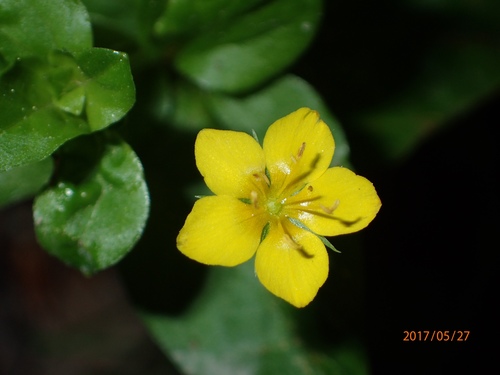
Yellow Pimpernel
Lysimachia nemorum
A hidden gem of the woodland floor, the Yellow Pimpernel offers a delicate display of star-shaped blooms and trailing greenery. Perfect for damp, shady spots, it is a favorite for backyard naturalists looking to document the quiet side of nature.
Quick Identification
Size
Trailing stems 10–40 cm (4–16 inches) long; flowers 12–15 mm (0.5 inches) in diameter.
Colors
Bright lemon-yellow petals with green sepals; medium-green foliage; stems can be tinged with reddish-purple.
Key Features
- Five-petaled, star-shaped yellow flowers
- Opposite, egg-shaped leaves with pointed tips
- Hairless, prostrate stems that creep along the ground
- Flowers held on long, slender stalks from leaf axils
When You’ll See Them
Behavior
Yellow Pimpernel is a low-growing perennial that brings a splash of light to the damp, shaded corners of a woodland garden. Unlike many garden plants that reach for the sky, this species prefers to weave itself across the ground, forming a delicate green tapestry. It is highly sensitive to light; its flowers generally only open fully when the sun is shining, closing up tightly during rain or as evening falls to protect its pollen.
While it is a quiet presence in the garden, it plays a vital role in the local ecosystem by providing early-season nectar for small pollinators. It is not an aggressive spreader like some of its relatives, making it a well-behaved neighbor for other native shade-loving plants. For humans, its presence is often a sign of healthy, undisturbed soil with consistent moisture levels.
EverydayEarth exclusive
Camera Tips
To successfully capture the Yellow Pimpernel on an AI-powered camera, you need to think low. Because these plants rarely rise more than a few inches off the forest floor, mount your camera on a ground-level stake or a small tripod, positioning the lens just 5 to 8 inches above the soil. A slight upward tilt can help capture the way the flowers sit atop their slender stalks. If your camera has a macro or close-focus setting, this is the time to use it, as the beauty of this species lies in the delicate structure of its five yellow petals and tiny central stamens.
Since plants don't move like animals, your AI trigger might not always fire on the plant itself. To get around this, use the 'Time-Lapse' mode if your camera supports it. Setting a capture every 10 to 15 minutes during the peak daylight hours (10 AM to 3 PM) will allow you to document the fascinating 'behavior' of the flowers as they open in response to the sun and track the light. This is also a great way to catch the 'incidental' wildlife that visits the plant, such as hoverflies and small solitary bees, which are often too fast or small to trigger standard motion sensors.
Lighting is your biggest challenge in the damp, shaded spots the Yellow Pimpernel calls home. Look for a patch of the plant that receives 'dappled' sunlight—where the sun breaks through the tree canopy. This creates a natural spotlight effect. Avoid using a heavy flash, which can wash out the delicate lemon-yellow color of the petals. If the area is very dark, a small, battery-operated LED light hidden in the foliage nearby can provide a gentle fill-light to help the AI better identify the yellow blooms against the dark green leaves.
Finally, consider the seasonal timing. Start your camera monitoring in late April so you don't miss the first blooms in May. Keep the area immediately around the target plant clear of tall grass or stray leaves that might blow in the wind and cause false triggers. Because Yellow Pimpernel thrives in damp areas, ensure your camera housing is treated with an anti-fog solution on the lens to prevent morning dew from blurring your shots.
Similar Species
Species that look similar or are commonly confused with Yellow Pimpernel.
Frequently Asked Questions
Record Yellow Pimpernel at your habitat
Connect a camera to start building your own species record — AI identifies every visitor automatically.