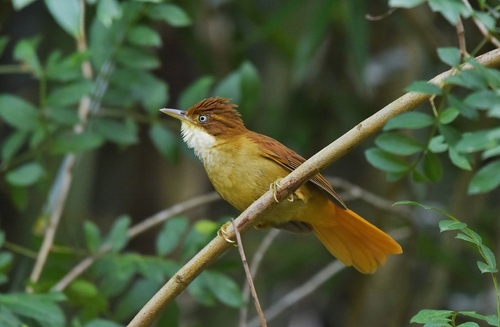
White-eyed Foliage-gleaner
Automolus leucophthalmus
A master of the Atlantic Forest undergrowth, the White-eyed Foliage-gleaner is easily identified by its piercing pale eyes and busy, leaf-tossing behavior. This industrious ovenbird is a key member of South America's most diverse woodland communities.
Quick Identification
Size
Length of 18–20 cm (7–8 in); weight ranges from 30–46 g (1.1–1.6 oz).
Colors
Olive-brown upperparts with a contrasting bright rufous tail and rump; creamy-white to buffy throat; most distinctively, a pale white to yellowish-white iris.
Key Features
- Striking white or pale-blue iris
- Bright rufous tail that contrasts with a duller brown back
- Heavy, slightly hooked bill used for prying debris
- Buffy-white throat often puffed out during vocalization
When You’ll See Them
Geographic range
Where Does the White-eyed Foliage-gleaner Live?
This bird is a native specialist of South America, primarily concentrated within the Atlantic Forest region. Its range extends across southeastern Brazil, from Bahia down to Rio Grande do Sul, reaching westward into eastern Paraguay and the Misiones province of northeastern Argentina. It is a sedentary species, remaining in these lush, humid forest environments throughout the year without undergoing migration.
Basemap © OpenStreetMap contributors
Behavior
The White-eyed Foliage-gleaner is an industrious and vocal inhabitant of the forest understory. True to its name, it spends the majority of its day 'gleaning' for food by rummaging through dead leaf clusters, prying under bark, and inspecting epiphytes. It is often heard before it is seen, possessing a loud, rhythmic, and somewhat harsh series of calls that help pairs maintain contact in the dense vegetation.
Socially, these birds are typically found in pairs or small family groups. They are highly active participants in mixed-species foraging flocks, often moving alongside woodcreepers and other ovenbirds. While they are relatively bold when foraging, they rely on the dense cover of the forest interior for protection, rarely venturing into wide-open spaces.
EverydayEarth exclusive
Camera Tips
To successfully capture the White-eyed Foliage-gleaner on camera, position your equipment within the forest understory rather than in open clearings. These birds are specialists of the lower to mid-story levels, so mounting your camera between 1 and 3 feet (30-90 cm) off the ground is ideal. Focus your lens on areas rich in leaf litter, fallen logs, or tangled vines, as these are their primary foraging grounds.
Because these birds inhabit the shaded forest interior, lighting can be a challenge. Use a camera with high ISO performance or a fast lens to manage the dim light without losing detail. Since they move with quick, jerky motions while tossing leaves, a fast trigger speed (less than 0.5 seconds) is crucial to avoid capturing a blur of brown feathers.
While they are unlikely to visit a traditional bird feeder, you can create a 'natural' lure by piling up extra dead leaves and dry palm fronds in a small area in front of your camera. This encourages the bird to stay in the frame longer as it searches for insects. If your camera has a 'quiet' shutter mode, enable it, as sharp mechanical clicks may startle the bird and cut your recording short.
Similar Species
Species that look similar or are commonly confused with White-eyed Foliage-gleaner.
Buff-browed Foliage-gleaner
Has a dark eye and a prominent buff-colored stripe above the eye (supercilium), whereas the White-eyed has a pale eye and no strong eye stripe.
Ochre-breasted Foliage-gleaner
Features a much more yellowish/ochre chest and lacks the bright white iris of the White-eyed Foliage-gleaner.
Frequently Asked Questions
Record White-eyed Foliage-gleaner at your habitat
Connect a camera to start building your own species record — AI identifies every visitor automatically.