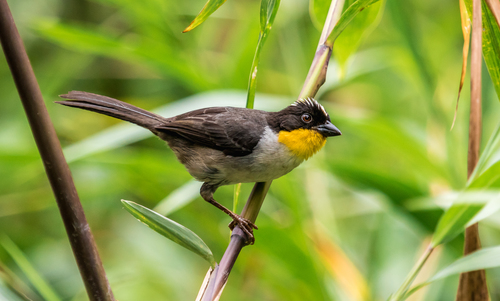
White-naped Brushfinch
Atlapetes albinucha
With its dapper black mask and a brilliant streak of white across its crown, the White-naped Brushfinch is a jewel of the highland thickets. This striking songbird brings a splash of vivid yellow and refined elegance to mountain gardens and forest edges alike.
Quick Identification
Size
16–18 cm (6.3–7.1 in) in length; weighs approximately 28–35 g (1.0–1.2 oz)
Colors
Striking jet-black head with a bold white stripe on the crown and nape; brilliant yellow throat and underparts; dark olive-green or slate-gray upperparts. Sexes appear identical.
Key Features
- Bold white stripe running from the forehead to the back of the neck
- Bright yellow throat and belly contrasting with black face
- Stout, dark bill
- Longish tail often held slightly cocked
When You’ll See Them
Behavior
The White-naped Brushfinch is an energetic and charismatic songbird that thrives in the dense understory. Unlike many high-flying species, these birds are masters of the 'low zone,' spending the majority of their lives within a few feet of the ground. They are famous for their scratching behavior, using both feet simultaneously to hop and kick back leaf litter to reveal hidden insects and seeds. While they can be secretive in deep forest, they often become quite bold in suburban gardens that offer plenty of cover.
Socially, they are usually seen in pairs or small family groups. They are highly territorial and will defend their patch of scrub with a series of high-pitched, thin whistling calls. They aren't much for long-distance flight; instead, they prefer to move through the environment with a series of agile hops and short, buzzing flights from one bush to another. Their presence is often announced by the rustling sound of dry leaves long before the bird itself is seen.
EverydayEarth exclusive
Camera Tips
To capture the best footage of a White-naped Brushfinch, you need to think like a ground-dweller. Position your camera very low—ideally between 12 and 18 inches off the ground. Aim the lens at a clear patch of earth near the base of a dense hedge or thicket. These birds feel safest near an immediate 'escape route' of tangled branches, so avoid placing cameras in the middle of wide-open lawns where they feel exposed to hawks.
A ground-level water feature, such as a shallow stone basin or a dripping fountain, is the ultimate lure for this species. They are meticulous bathers and will visit a reliable water source daily. If you are using an AI-powered camera, set the motion sensitivity to high. Because brushfinches move with quick, jerky hops and frequent tail-flicks, a slow trigger speed may result in nothing but a blurry yellow streak. A fast shutter speed is essential to freeze their rapid movements in the low-light conditions of their preferred shady habitats.
For baiting, these birds are highly attracted to mealworms or a specialized 'bug and nut' suet mix placed on a flat rock or log. Since they are used to scratching through debris, scattering a little bit of birdseed under a layer of dry leaves in front of the camera can trigger their natural foraging behavior, leading to longer, more engaging video clips. Seasonally, keep your camera active during the nesting months; you may catch the charming sight of parents leading fledglings to your feeding station.
Similar Species
Species that look similar or are commonly confused with White-naped Brushfinch.
Frequently Asked Questions
Record White-naped Brushfinch at your habitat
Connect a camera to start building your own species record — AI identifies every visitor automatically.