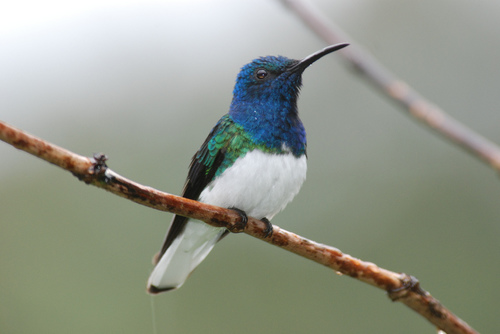
White-necked Jacobin
Florisuga mellivora
Meet the monarch of the hummingbird world. With its regal blue hood and striking snowy tail, the White-necked Jacobin turns every backyard visit into a high-speed masterclass in elegance.
Quick Identification
Size
11-12 cm (4.3-4.7 in) in length; weighs 6-10 g (0.21-0.35 oz)
Colors
Males feature a deep iridescent blue head and chest, a white 'collar' on the nape, and a brilliant white tail. Females are typically scaly green above and white below with dark spotting, though some look identical to males.
Key Features
- Iridescent deep blue hood and chest on males
- Bright white patch on the back of the neck
- Large, broad white tail often fanned during flight
- Heavy, straight black bill
- Androchromatism where some females mimic male plumage
When You’ll See Them
Sightings on EverydayEarth
Apr 1, 2026
A high-energy scene at the nectar station with at least seven hummingbirds visible. Male White-necked Jacobins and Blue-chested Hummingbirds are actively feeding, hovering, and jockeying for position around the red feeder tray in the late afternoon light.
Apr 13, 2026
A lively scene unfolds at the nectar feeder as multiple hummingbirds compete for a spot. A White-necked Jacobin perches prominently, displaying its striking blue head and white tail while feeding. A Long-billed Hermit briefly appears on the left with its characteristic curved beak, while a Blue-chested Hummingbird darts in and out of the frame. Several small insects are also seen buzzing around the feeder ports.
Apr 13, 2026
A White-necked Jacobin is perched on the right side of the red feeder, calmly drinking nectar. A Blue-chested Hummingbird briefly appears on the left, hovering near the feeding ports for a few seconds before darting out of view. The Jacobin continues to feed and look around for the remainder of the clip.
Apr 13, 2026
A bustling scene at the hummingbird feeder features a variety of species. A male White-necked Jacobin is particularly active, often hovering or perching to drink. Several Blue-chested and Snowy-bellied Hummingbirds flit in and out, competing for space. A Long-billed Hermit makes a quick appearance, using its long curved beak to feed briefly before flying off.
Apr 13, 2026
A White-necked Jacobin and a Blue-chested Hummingbird are perched at the red nectar feeder. A second Blue-chested Hummingbird arrives from the right, fluttering around the feeder to compete for a spot. The Jacobin eventually takes flight, leaving the two smaller hummingbirds to feed in the lush, green tropical environment.
Apr 12, 2026
A bustling scene at the feeder with multiple hummingbirds interacting. A White-necked Jacobin frequently hovers and darts around the center, while several Blue-chested and Snowy-bellied hummingbirds compete for positions at the feeding ports. The birds are highly active, constantly displacing each other and hovering in the humid afternoon air.
Behavior
The White-necked Jacobin is a high-energy, dominant hummingbird known for its bold presence at feeding stations. Unlike smaller, more timid species, the Jacobin often stakes out a 'claim' over a specific feeder or flower patch, aggressively chasing away intruders. They are exceptionally agile fliers, frequently seen hovering with their large white tails fanned out to signal dominance or attract mates.
A fascinating aspect of their social behavior is female polymorphism. Approximately 20% of females possess the bright, flashy plumage of males. Research suggests this isn't for attracting mates, but rather a survival strategy; by looking like the aggressive males, these 'androchrome' females avoid being bullied at food sources, allowing them more time to feed peacefully. In suburban settings, they are curious and can become accustomed to human presence, often hovering just a few feet away from observers.
EverydayEarth exclusive
Camera Tips
To capture the stunning iridescence of the White-necked Jacobin, camera placement is everything. Position your AI camera at eye-level with a nectar feeder or a cluster of Heliconia flowers. Because these birds are remarkably fast, use a camera with a high frame rate or a 'pre-roll' feature that captures action just before the trigger. Aim for a side-profile angle to catch the contrast between the deep blue hood and the snowy white tail feathers, which are their most photogenic feature.
Lighting is your biggest challenge and best friend. The iridescent blue feathers require bright light to 'pop,' but the white tail can easily become overexposed and lose detail in harsh midday sun. Set your camera in a spot that receives bright, indirect morning light. If your camera allows for manual exposure settings, underexpose by 0.3 or 0.7 stops to preserve the texture in those bright white feathers. Early morning (just after sunrise) provides the softest light that highlights the metallic sheen of their green backs without blowing out the whites.
To get 'natural' shots that don't just show the bird at a plastic feeder, place a thin, lichen-covered perch about two feet away from your food source. Jacobins are creatures of habit and will often land on the same twig to survey the area before feeding. Focus your camera on this 'staging' branch. You can also use a macro lens if your setup allows, as these hummingbirds are quite large for their family and will fill the frame beautifully. If you are using a trail camera, ensure the PIR sensor is set to its highest sensitivity, as their small body heat signature and rapid movement can sometimes be missed by slower sensors.
During the rainy season, don't put the camera away. White-necked Jacobins often continue feeding during light tropical showers. Capturing a Jacobin mid-air with water droplets shaking off its feathers creates a world-class wildlife photograph. Ensure your camera housing is waterproof and try to capture the action against a dark, out-of-focus foliage background to make the bird's colors and the raindrops stand out.
Similar Species
Species that look similar or are commonly confused with White-necked Jacobin.
Black-throated Mango
The Mango has a noticeably curved bill and a dark vertical stripe down its chest, whereas the Jacobin has a straight bill and a solid blue hood.
Blue-throated Goldentail
Smaller with a reddish bill base and a metallic copper-gold tail, lacking the Jacobin's signature white tail feathers.
Frequently Asked Questions
Record White-necked Jacobin at your habitat
Connect a camera to start building your own species record — AI identifies every visitor automatically.