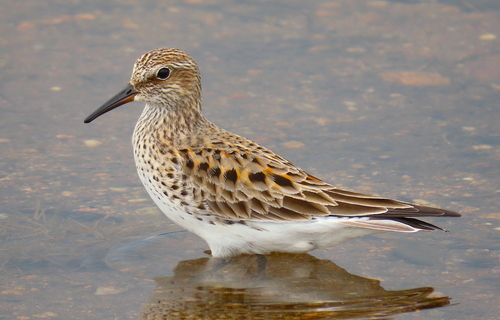
White-rumped Sandpiper
Calidris fuscicollis
A marathon migrant that travels from the Arctic to South America, the White-rumped Sandpiper is a master of endurance. Look for their uniquely long wings and distinctive white patch as they refuel in muddy wetlands.
Quick Identification
Size
Length: 15–19 cm (6–7.5 in); Wingspan: 38–44 cm (15–17 in); Weight: 35–50 g (1.2–1.8 oz)
Colors
Mottled gray-brown and black upperparts; white underparts with fine streaking on the breast and flanks; prominent white rump patch visible only in flight; dark legs.
Key Features
- Primary feathers extend significantly past the tail tip at rest
- Distinct white rump patch visible during flight
- Slightly decurved, thin black bill
- Fine, dense streaking on the upper breast and along the flanks
When You’ll See Them
Behavior
The White-rumped Sandpiper is one of nature's most impressive long-distance travelers, performing a massive annual migration from the high Arctic to the southern tip of South America. These birds are often described as methodical foragers; unlike some of their more frantic relatives, they tend to move at a steadier pace, carefully probing the mud with their bills to locate prey. They are social birds, frequently found in mixed-species flocks of other small shorebirds, affectionately known by birders as 'peeps.'
In terms of human interaction, they are notably less skittish than larger shorebirds. If approached slowly, they often continue their business of feeding, making them excellent subjects for observation. Their presence in any given area is usually brief, as they use stopover sites to rapidly put on fat reserves—sometimes doubling their body weight—before embarking on the next multi-thousand-mile leg of their journey.
EverydayEarth exclusive
Camera Tips
To capture high-quality footage of a White-rumped Sandpiper, your camera must be positioned extremely low to the ground. These birds spend nearly all their time at the water's edge, so mounting your camera on a short stake or even a flat 'ground pod' just a few inches above the mud is ideal. This low angle provides an intimate perspective and helps the AI more easily distinguish the bird's profile against the background. Because they frequent damp environments, ensure your camera has a high waterproof rating or is enclosed in a protective housing to guard against splashing and humidity.
Since these birds are highly migratory and seasonal, placement is most effective near 'draw-down' areas—places where water levels are receding to expose fresh mud. If you have a backyard pond or a large birdbath, you can encourage a visit by keeping a portion of the perimeter clear of tall vegetation. Sandpipers feel safer in open areas where they can spot predators from a distance. Setting your camera to a high frame rate or a 'burst' photo mode is beneficial, as it allows you to capture the moment they stretch their wings, which is often the only time the diagnostic white rump patch is visible.
Lighting is another crucial factor for capturing the subtle details of 'peeps.' Early morning or late afternoon sun provides the best directional light to highlight the fine streaking on their breast and the length of their primary feathers—key features for distinguishing them from other similar sandpipers. If using a motion-activated trail camera, set the trigger sensitivity to 'High,' as these small birds may not always trip sensors designed for larger mammals. Avoid using lures or baits, as these birds are strictly insectivorous and are best attracted by providing the right muddy habitat.
Similar Species
Species that look similar or are commonly confused with White-rumped Sandpiper.
Baird's Sandpiper
Baird's also has long wings that overlap the tail, but it lacks the pure white rump patch and has a more scaly, buff-colored back.
Least Sandpiper
The Least Sandpiper is noticeably smaller with yellowish legs, while the White-rumped has dark legs and a longer body profile.
Semipalmated Sandpiper
The Semipalmated has shorter wings that do not extend past the tail and a shorter, thicker bill.
Frequently Asked Questions
Record White-rumped Sandpiper at your habitat
Connect a camera to start building your own species record — AI identifies every visitor automatically.