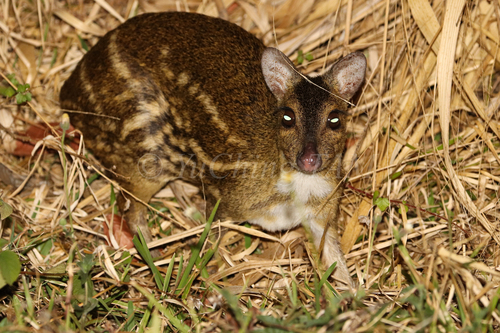
White-spotted Chevrotain
Moschiola meminna
A living relic of the ancient forest, the White-spotted Chevrotain is one of the world's smallest and most secretive hoofed mammals. This 'mouse-deer' tiptoes through the Sri Lankan undergrowth, using its dappled coat to vanish into the shadows.
Quick Identification
Size
Length: 45–60 cm (18–24 in); Shoulder height: 20–25 cm (8–10 in); Weight: 2–4.5 kg (4.5–10 lbs)
Colors
Dark brown to grizzled-ochre coat with 4-5 longitudinal rows of distinct white spots and broken stripes on the flanks; throat has three white stripes; belly is creamy white.
Key Features
- Tiny, deer-like body with a rounded back and slender legs
- White spots arranged in clear horizontal lines along the sides
- Lack of antlers in both sexes; males possess protruding upper canine 'tusks'
- Four well-developed toes on each foot
When You’ll See Them
Behavior
These mammals are primarily nocturnal, though they may occasionally be active during the early morning or late evening if they feel secure. Unlike larger deer, they do not have a strong social structure; sightings of more than one individual usually indicate a mother with her fawn or a brief mating encounter. When threatened, they exhibit a 'freeze' response, relying on their camouflaged spots to blend into the dappled light of the forest floor before suddenly bolting into the brush.
EverydayEarth exclusive
Camera Tips
Choose a location with dense ground cover or a known animal trail near a water source. These 'mouse-deer' prefer to stay under the protection of thickets, so placing your camera at the mouth of a 'game tunnel' through heavy brush is highly effective. Since they are strictly nocturnal, a camera with high-quality 'No-Glow' infrared flash is mandatory. Standard 'Low-Glow' LEDs may emit a faint red light that can spook these hypersensitive animals, causing them to avoid the area in the future.
If you are monitoring a backyard or garden area adjacent to forest land, you can encourage them to pause in front of your lens using fallen fruit. They are particularly fond of seasonal local fruits like wood-apple or even small pieces of fallen jackfruit. Scatter the fruit in a small, 2-foot diameter circle to keep the animal centered in your frame. Avoid using mineral licks or salt blocks, as these are less effective for chevrotains than fresh, fragrant fruit.
For camera settings, prioritize a fast trigger speed and use 'Burst Mode' or 'Photo + Video' mode. Chevrotains have very twitchy, rapid movements; they often stop, sniff the air, and dart away in a heartbeat. A 10-20 second video clip is the best way to observe their fascinating behavior, such as their delicate 'tiptoe' walking style or the way they use their long tongues to forage. Ensure your PIR sensitivity is set to 'High' to detect their small, low-mass bodies.
Similar Species
Species that look similar or are commonly confused with White-spotted Chevrotain.
Frequently Asked Questions
Record White-spotted Chevrotain at your habitat
Connect a camera to start building your own species record — AI identifies every visitor automatically.