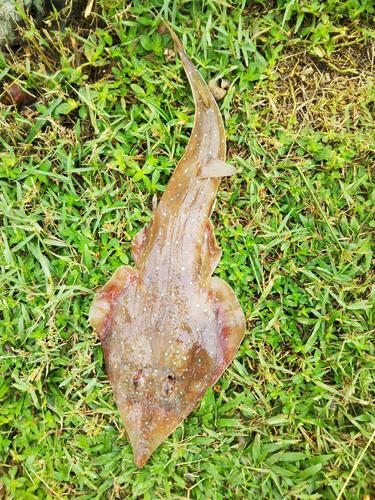
White-spotted Guitarfish
Rhinobatos albomaculatus
A mesmerizing blend of shark-like power and ray-like grace, the White-spotted Guitarfish is a hidden gem of the West African coast. Its starry-patterned back provides the perfect camouflage for a life spent patrolling the sandy ocean floor.
Quick Identification
Size
Up to 75 cm (29.5 inches) in length; weighing between 2-4 kg (4.4-8.8 lbs).
Colors
Olive-brown or sandy-grey dorsal surface with distinct, small white spots; creamy white or pale underside.
Key Features
- Wedge-shaped head and snout resembling a guitar body
- Prominent shark-like tail with two large dorsal fins
- Symmetrical white spots scattered across the upper body
- Small, pavement-like teeth for crushing shells
When You’ll See Them
Behavior
During the day, they often employ a 'settling' behavior where they use their pectoral fins to stir up sand, allowing it to settle over their bodies for camouflage against predators. While they are generally solitary, they are not aggressively territorial and can be found in higher densities where crustaceans are plentiful. They are harmless to humans and are known for being quite shy, often darting away at the first sign of heavy vibration or sudden movement.
EverydayEarth exclusive
Camera Tips
Because these fish are almost exclusively nocturnal, lighting is your most critical factor. White-spotted Guitarfish have sensitive eyes; a harsh white flash will likely cause them to 'flee' the frame immediately. Use a camera with high-intensity infrared (IR) LEDs or a diffused red light source, which is less visible to marine life. If you are using a triggered trail camera, set the detection sensitivity to high, as their streamlined bodies moving slowly across the sand may not always trigger passive sensors.
Using a scent lure is the most effective way to bring a guitarfish into your camera's field of view. Place a mesh 'chum bag' filled with crushed oily fish or crab shells about one meter in front of the lens. Secure the bag to a weight so it doesn't drift. This encourages the fish to stop and forage, providing you with high-quality, still shots or long video clips of their natural feeding behavior.
Check the tides before deploying your equipment. The clearest footage is usually captured during the 'slack water' period of high tide when sediment settles and visibility is at its peak. If you are setting up in a coastal backyard lagoon, ensure your mount is heavy enough to withstand tidal currents, as a shifting camera will result in blurry footage and may spook the fish.
Similar Species
Species that look similar or are commonly confused with White-spotted Guitarfish.
Frequently Asked Questions
Record White-spotted Guitarfish at your habitat
Connect a camera to start building your own species record — AI identifies every visitor automatically.