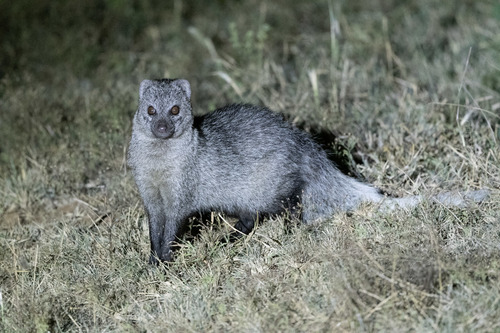
White-tailed Mongoose
Ichneumia albicauda
The ghost of the garden, the White-tailed Mongoose is a solitary nocturnal hunter known for its striking white tail and elegant, high-stepping gait. Spotting one on your camera is a sign of a healthy, biodiverse backyard ecosystem.
Quick Identification
Size
70–110 cm (28–43 in) total length; 2.9–5.2 kg (6.4–11.5 lbs)
Colors
Grizzled grey to brownish-yellow body with distinct black legs and a large, bushy tail that is usually white but can be brownish in some regions.
Key Features
- Large, bushy white tail comprising nearly 40% of body length
- Long, black-furred legs giving a high-standing profile
- Pointed muzzle with a dark, wet nose
- Coarse salt-and-pepper coat texture
When You’ll See Them
Behavior
The white-tailed mongoose is the largest of all mongoose species and a true creature of the night. Unlike their more famous, social cousins like meerkats, these animals are primarily solitary and strictly nocturnal. They spend their daylight hours resting in abandoned termite mounds, hollow logs, or burrows they've excavated themselves, only emerging once the sun has completely set to begin their nightly patrol.
When moving through their territory, they exhibit a characteristic high-stepping trot, keeping their heads low to the ground to sniff out prey. While generally shy and quick to retreat into the shadows when they sense a human presence, they are surprisingly bold hunters. In suburban areas bordering natural habitats, they are known to be quite adaptable, often visiting the same gardens nightly if there is a reliable source of food or water.
EverydayEarth exclusive
Camera Tips
To capture high-quality footage of the white-tailed mongoose, you must prioritize your camera's night-vision capabilities. Use a 'No-Glow' or 'Black LED' infrared flash to avoid spooking this wary species. Since they are low-slung but have long legs, mount your camera approximately 12 to 18 inches off the ground. If the camera is too high, you’ll likely only capture the top of their backs; a lower angle provides a much more intimate, eye-level view of their face and markings.
Placement is key for this species. Look for natural funnels such as gaps in garden fences, narrow paths through long grass, or the edges of water features. They are habitual creatures and will often use the exact same trail every night. If you have a compost pile or an area with rotting logs, these are excellent spots to aim your camera, as the mongoose will spend significant time there foraging for the insects and larvae found in the decaying organic matter.
Because the white-tailed mongoose is quite long, especially with that bushy tail, set your camera to a 'Burst' mode of 3 to 5 photos or a video clip of at least 15-20 seconds. A single photo often misses the most identifying feature—the tail—as the animal moves past the sensor. Video is particularly effective for observing their unique 'pouncing' hunting style and their vocalizations, which include unusual barking or growling sounds if they encounter another animal.
If you aren't seeing results, try a scent lure. A small amount of wet cat food or a cracked egg near a fallen log can encourage them to pause long enough for a clear shot. During the dry season, a shallow water dish is often the best attractant, as these mammals need to drink regularly. Make sure your camera's PIR (Passive Infrared) sensitivity is set to 'High' to ensure the sensor picks up their heat signature in the cooler night air.
Similar Species
Species that look similar or are commonly confused with White-tailed Mongoose.
Frequently Asked Questions
Record White-tailed Mongoose at your habitat
Connect a camera to start building your own species record — AI identifies every visitor automatically.