Whiteface Waspfish
Paracentropogon longispinis
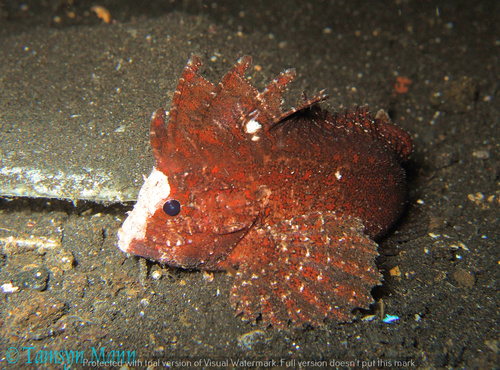
A master of underwater disguise, the Whiteface Waspfish perfectly mimics a drifting leaf to hide from predators and ambush its tiny prey.
Quick Identification
Size
Small and compressed, reaching a maximum length of 8–10 cm (3.1–3.9 inches).
Colors
Highly variable mottled patterns of reddish-brown, tan, and purplish-black; most individuals feature a prominent white or pale vertical 'blaze' or stripe on the face and forehead.
Key Features
- High, sail-like dorsal fin starting above the eyes
- Distinctive white facial stripe or blaze
- Compressed, leaf-like body shape
- Venomous dorsal spines
- Camouflaged mottled coloration
When You’ll See Them
Geographic range
Where Does the Whiteface Waspfish Live?
The Whiteface Waspfish is native to the warm, tropical waters of the central Indo-West Pacific, a region renowned for its immense marine biodiversity. Its core range extends from the Andaman Sea and Thailand through the Indonesian archipelago and the Philippines, reaching as far south as the northern coastal waters of Australia. This species is a true resident of the 'Coral Triangle,' where it thrives in the shallow, nutrient-rich margins between coral reefs and sandy sea floors.
Basemap © OpenStreetMap contributors
Behavior
The Whiteface Waspfish is a master of mimicry and stealth, often spending its entire day swaying rhythmically to and fro. This 'rocking' behavior is a specialized form of camouflage designed to mimic a piece of dead leaf or marine debris caught in the current, allowing the fish to hide in plain sight from both predators and unsuspecting prey.
This species is a solitary bottom-dweller, rarely swimming in open water. Instead, it uses its pelvic fins to 'walk' or scoot along the substrate. While generally docile and slow-moving, it possesses highly venomous spines along its dorsal fin as a defense mechanism. In the wild, they are ambush predators that rely on their incredible disguise to get within striking distance of small crustaceans.
EverydayEarth exclusive
Camera Tips
To capture the elusive Whiteface Waspfish on an underwater AI camera, you must focus on 'muck' diving environments rather than high-energy reef crests. Position your camera housing on sandy or silty patches near the base of reefs or within seagrass meadows. Because these fish are benthic and stay very low to the ground, the camera should be mounted just 10–15 centimeters (4–6 inches) above the substrate, tilted slightly downward to capture the fish’s profile against the sand.
Since the Whiteface Waspfish relies on its leaf-like appearance, it often settles near actual debris. Look for areas with scattered leaf litter or small rubble piles. A stationary camera is most effective here; the AI can be trained to recognize the specific 'rocking' motion that the fish uses to mimic debris. If your camera has a macro lens or a close-focus setting, use it—these fish are small and their most distinguishing feature, the white facial blaze, requires high detail to be identified accurately by most computer vision models.
Lighting is the most critical factor for success. While they are active during the day, their mottled colors often blend into the shadows. Use a setup with dual video lights or a filtered red light at night to reveal their true colors without spooking them. Using a scent-based lure, such as a small mesh bag containing crushed shrimp or fish waste, can attract the tiny crustaceans that the Waspfish hunts. This will keep the predator within the camera's field of view for much longer periods as it waits for its 'dinner' to arrive.
Similar Species
Species that look similar or are commonly confused with Whiteface Waspfish.
Frequently Asked Questions
Record Whiteface Waspfish at your habitat
Connect a camera to start building your own species record — AI identifies every visitor automatically.