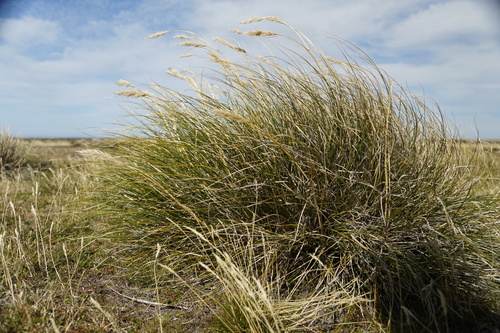
Whitegrass
Cortaderia pilosa
The shimmering soul of the southern moorlands, Whitegrass is a resilient tussock that provides shelter and beauty in the face of the wind. Its silvery plumes create a dramatic backdrop for the hardy wildlife of the sub-Antarctic.
Quick Identification
Size
Height of 30-60 cm (12-24 in), with flowering plumes reaching up to 1 meter (3.3 ft)
Colors
Pale green to golden-straw foliage with distinctive silvery-white or cream flowering plumes
Key Features
- Dense, hummock-forming tussock growth habit
- Silvery, silky flower panicles (plumes)
- Narrow, folded leaves that are often hairy
- Dominant ground cover in southern moorlands
When You’ll See Them
Behavior
In its native ecosystem, Whitegrass is a foundational species. It creates a complex physical structure on the ground, offering protection to smaller plants and serving as a vital microhabitat for invertebrates. While it is often used as rough grazing for livestock, its high fiber content and tough blades make it a resilient survivor that remains standing even after heavy frosts or snow.
EverydayEarth exclusive
Camera Tips
The silvery-white plumes of Whitegrass are highly reflective. During the night, your camera’s infrared (IR) flash can hit these plumes and cause a 'white-out' effect, obscuring any animals in the frame. To avoid this, angle your camera so the largest plumes are in the background or at the periphery of the shot, rather than directly in front of the lens. Using a camera with 'No-Glow' IR can also help in reducing the harshness of the reflection on the pale grass blades.
For the best results, look for 'wildlife highways'—flattened paths or gaps between the Whitegrass hummocks where animals like penguins, foxes, or ground-nesting birds regularly travel. Set your camera to 'Hybrid Mode' (photo followed by video) to capture both the presence and the behavior of animals as they navigate the dense grass. If you are interested in the plant's life cycle, a long-term timelapse (one photo every 4 hours) from December through February will beautifully document the emergence and swaying of the iconic silver plumes.
Similar Species
Species that look similar or are commonly confused with Whitegrass.
Frequently Asked Questions
Record Whitegrass at your habitat
Connect a camera to start building your own species record — AI identifies every visitor automatically.