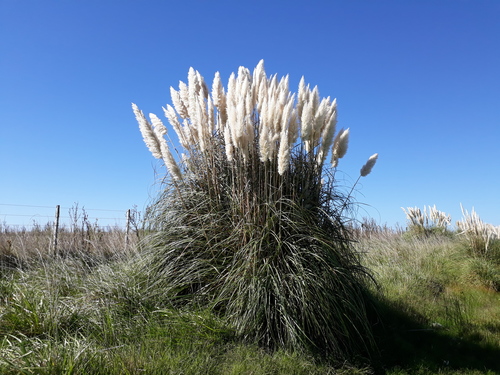
Pampas Grass
Cortaderia selloana
With its towering silvery plumes and dramatic fountain-like foliage, Pampas Grass is a striking architectural giant of the plant world. Whether swaying in a coastal breeze or glowing in the sunset, it creates a majestic backdrop for any backyard wildlife gallery.
Quick Identification
Size
Height of 2–4 meters (6–13 feet); spread of up to 2 meters (6.5 feet); plumes can reach 1 meter (3 feet) in length.
Colors
Sharp, serrated blue-green or silver-green leaves; flower plumes are typically creamy white, silvery-grey, or occasionally light pink.
Key Features
- Massive, feathery flower plumes (panicles) held high above foliage
- Dense, fountain-like clumping habit (tussocks)
- Long, narrow leaves with razor-sharp, saw-toothed edges
- Stiff, upright stalks that remain standing through winter
When You’ll See Them
Behavior
Pampas Grass is a perennial grass known for its rapid growth and hardiness. It grows in large, dense clumps called tussocks, which can become so thick that they provide significant cover for small rodents and reptiles. While it looks soft and decorative, the plant is physically formidable; its leaf blades contain high levels of silica, making the edges sharp enough to cut human skin or animal fur.
As a wind-pollinated species, it relies on the breeze to spread its genetic material. A single female plant can produce up to 100,000 seeds per plume, which can travel miles on the wind. This efficient reproductive strategy, combined with its ability to grow in poor soil, has led it to become a highly invasive species in regions outside its native South American range, often outcompeting native plants for sun and space.
EverydayEarth exclusive
Camera Tips
Capturing Pampas Grass on a backyard camera requires a different approach than moving wildlife. Because trail cameras are usually triggered by Heat and Motion (PIR sensors), the grass itself might not trigger the camera unless it is a very hot day and the grass is blowing vigorously. To capture the best footage, use the 'Time Lapse' mode on your camera. Set it to take a photo every 15 to 30 minutes during the day to create a stunning video of the plumes swaying and growing over the season.
The visual appeal of Pampas Grass is all about texture and light. Position your camera to the west of the plant, facing east, to capture 'backlighting' during the golden hour of sunset. This makes the feathery plumes appear to glow or have a halo effect. Avoid placing the camera too close; the sharp leaves can whip in the wind and scratch your camera lens or create 'motion blur' that ruins the shot. A distance of 10-15 feet is ideal for a full-clump profile.
If you are using the grass as a backdrop to catch birds or small mammals, place the camera at a low angle (about 1-2 feet off the ground) pointed toward the base of the tussock. Many small birds like sparrows and finches visit Pampas Grass to collect the feathery fluff for nesting material or to pick at seeds. If your camera has a 'Hybrid' mode, use it to capture a high-res photo followed by a 10-second video to see the interaction between the wildlife and the swaying stalks.
During the winter months, don't move your camera! The dried, golden stalks and plumes provide excellent contrast against snow or grey skies. Ensure your camera is secured to a sturdy post rather than a flexible branch, as the wind resistance of a large Pampas clump can cause significant ground vibration that might result in false triggers or shaky footage.
Similar Species
Species that look similar or are commonly confused with Pampas Grass.
Frequently Asked Questions
Record Pampas Grass at your habitat
Connect a camera to start building your own species record — AI identifies every visitor automatically.