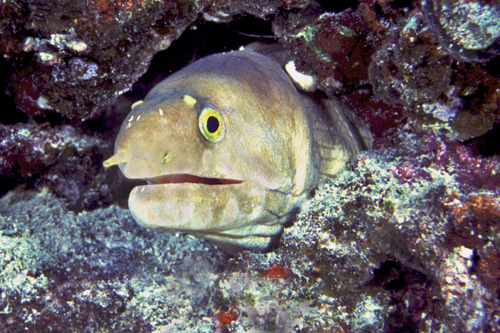
Whitemargin Moray
Gymnothorax albimarginatus
A phantom of the deep reef, the Whitemargin Moray is easily identified by the striking pearlescent trim on its fins and its calm, steady gaze. This elusive nocturnal hunter represents the mysterious beauty of the Indo-Pacific's twilight zones.
Quick Identification
Size
Reaches a maximum length of approximately 100 cm (39 inches) and can weigh up to 2.5 kg (5.5 lbs).
Colors
Uniformly light brown to tan body; distinctive bright white margins on the dorsal and anal fins; a dark, almost black spot typically surrounds the gill opening.
Key Features
- Bright white border along the dorsal and anal fins
- Uniformly tan or light-brown body without spots
- Black smudge or spot around the gill opening
- Blunt, rounded snout with a relatively small eye
When You’ll See Them
Geographic range
Where Does the Whitemargin Moray Live?
This marine species is widely distributed throughout the tropical Indo-Pacific, spanning from the eastern coast of Africa and the Red Sea to the Hawaiian Islands and the Marquesas. Its range extends north to the Ryukyu Islands of Japan and south toward the Great Barrier Reef in Australia. Because it prefers deeper reef habitats, it is most commonly found in the pristine waters of oceanic islands and continental shelf edges.
Basemap © OpenStreetMap contributors
Behavior
The Whitemargin Moray is a secretive and primarily nocturnal predator that spends its days hidden within the complex architecture of the coral reef. Unlike some more gregarious eel species, it is relatively shy and is most often seen with only its head protruding from a crevice. It performs a characteristic mouth-gaping motion which, while appearing aggressive to the uninitiated, is actually a vital respiratory action used to pump oxygen-rich water over its gills.
Socially, these eels are solitary and territorial regarding their preferred hiding spots. They are known for their sit-and-wait hunting style, relying on their exceptional sense of smell to detect prey moving through the dark. While they are generally not aggressive toward divers, they can be defensive if they feel cornered or if their lair is encroached upon, making them a fascinating but hands-off subject for underwater observers.
EverydayEarth exclusive
Camera Tips
Capturing high-quality footage of the Whitemargin Moray requires specialized underwater equipment, as this species is rarely found in the shallow waters accessible to standard shore-based cameras. To find them, position your camera housing near deep reef ledges or rocky outcroppings between 30 and 50 meters. Because they are nocturnal, you will need a powerful artificial light source; however, use red-filtered lights or low-intensity wide beams initially, as a sudden blast of white light can cause the eel to retreat deep into its burrow.
For the best results, use a scent-based lure to encourage the eel to emerge fully from its crevice. A perforated PVC tube filled with crushed sardines or oily mackerel works well when anchored securely in front of a known eel lair. This provides the 'bait' without allowing the eel to swim away with it immediately, giving your camera time to capture the distinctive white-edged fins and undulatory swimming motion. Ensure your camera is set to a high frame rate, as their movements can be surprisingly quick when they strike.
Stability is critical on deep reef slopes where currents can be unpredictable. Use a weighted tripod or a heavy camera tray to ensure your frame remains steady. If your camera has a 'time-lapse' or 'motion-detect' feature that works underwater, set it to trigger in the early evening. The transition from dusk to full darkness is the 'golden hour' for morays, as this is when they are most likely to leave their holes to begin their nightly foraging.
Similar Species
Species that look similar or are commonly confused with Whitemargin Moray.
Frequently Asked Questions
Record Whitemargin Moray at your habitat
Connect a camera to start building your own species record — AI identifies every visitor automatically.