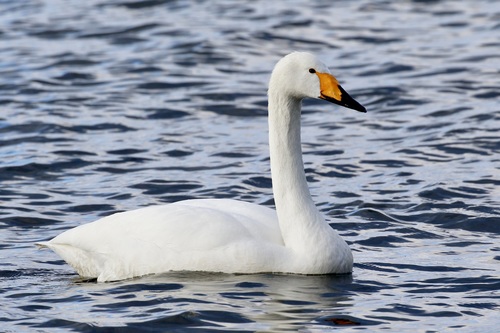
Whooper Swan
Cygnus cygnus
The Whooper Swan is a magnificent winter visitor, recognizable by its straight, slender neck and striking yellow-and-black bill. These powerful migrants bring a sense of wildness and a haunting bugle call to northern wetlands.
Quick Identification
Size
Length: 140–165 cm (55–65 in); Wingspan: 205–275 cm (81–108 in); Weight: 7–14 kg (15–31 lbs)
Colors
Adults are entirely white; juveniles are smoky grey-brown. Bill is black with a large, wedge-shaped yellow patch.
Key Features
- Large yellow patch on the bill extending past the nostril in a pointed shape
- Long, slender neck usually held straight rather than curved
- Large, heavy body with a relatively flat-topped head
- Loud, bugling trumpeting call often heard in flight
When You’ll See Them
Behavior
Whooper Swans are highly social and vocal birds, best known for their powerful, bugle-like calls that can be heard from miles away. Unlike the more common Mute Swan, Whoopers are migratory, spending their summers in the subarctic and traveling south to temperate wetlands and agricultural fields for the winter. They are often seen in tight-knit family groups, with parents and their grey-tinted offspring remaining together throughout the first winter.
These swans are generally more cautious and wilder than urban-dwelling swans, preferring open spaces where they can spot predators from a distance. In the winter, they spend much of their time foraging in flooded fields or shallow lakes. They perform elaborate social displays, including synchronized head-bobbing and wing-shaking, which reinforce pair bonds and communicate status within the larger flock.
EverydayEarth exclusive
Camera Tips
To capture high-quality footage of Whooper Swans, camera placement is everything. These birds are tall and carry their heads high, so position your camera on a bank or a sturdy stake about 2 to 3 feet off the ground. If you are monitoring a water's edge, angle the camera slightly upward to account for their height. Because they are easily spooked by unusual objects, use natural camouflage like reeds or tall grass to break up the silhouette of your camera housing.
Exposure settings are critical when filming Whooper Swans due to their brilliant white plumage. On bright days, white feathers reflect a massive amount of light, which can cause the image to 'blow out' and lose all detail. If your camera allows for exposure compensation, set it to -1.0. If not, try to position the camera so the sun is behind it, providing direct, even light during the early morning 'golden hour' when the swans are most active and the light is softest.
Identify 'staging areas' for the best results. Look for muddy banks with large webbed footprints or areas of flattened grass near water bodies where the swans gather to preen and rest. These spots provide much better opportunities for behavior shots—such as wing stretching or social interactions—compared to a bird simply swimming past. If using a trail camera, a 20-second video clip is preferred over still photos to capture their unique 'whooping' vocalizations and the social dynamics of the family group.
Similar Species
Species that look similar or are commonly confused with Whooper Swan.
Frequently Asked Questions
Record Whooper Swan at your habitat
Connect a camera to start building your own species record — AI identifies every visitor automatically.