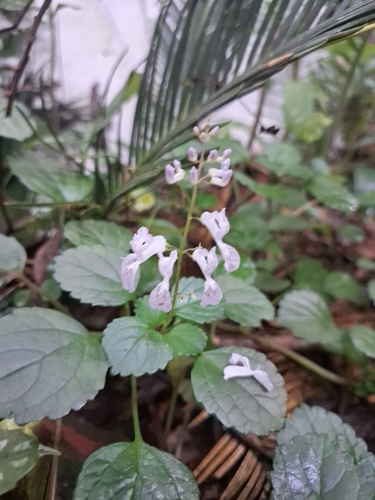
Whorled plectranthus
Plectranthus verticillatus
A lush, trailing treasure from southern Africa, the Whorled plectranthus brightens shaded corners with its high-gloss foliage and delicate flower spikes. Despite its common name, this 'Swedish Ivy' is a resilient member of the mint family that thrives in the dappled light of suburban backyards.
Quick Identification
Size
4–12 inches (10–30 cm) tall with a trailing spread of 2–3 feet (60–90 cm)
Colors
Bright emerald green foliage with glossy surfaces; often features purplish-maroon undersides on the leaves; small white to pale mauve flowers.
Key Features
- Glossy, rounded leaves with scalloped (crenate) edges
- Square, succulent-like stems typical of the mint family
- Small white or lavender tubular flowers on upright spikes
- Creeping or cascading growth habit
When You’ll See Them
Behavior
The Whorled plectranthus is a vigorous and resilient perennial that behaves as both a ground-hugging trailer and a cascading ornamental. While it lacks the sentient behavior of animals, it is highly phototropic, meaning its stems and leaves will actively orient themselves toward the strongest light source. In a garden setting, it spreads via 'creeping' stems that root at the nodes whenever they touch moist soil, allowing a single plant to quickly create a lush, green carpet.
During its blooming phase in late summer and autumn, it becomes a hub of activity for local pollinators. The plant produces upright racemes of delicate flowers that provide nectar for small bees, hoverflies, and occasionally butterflies. It is known for its 'polite' growth compared to true ivies, as it does not use invasive aerial roots to climb and damage structures, making it a favorite for backyard enthusiasts who want greenery without the structural risk.
EverydayEarth exclusive
Camera Tips
To truly capture the 'life' of Whorled plectranthus, switch your camera to a time-lapse mode. Because plants move slowly, a frame-per-hour setting over a period of 14 days is ideal for documenting the 'creeping' behavior of the stems as they seek out new soil. Position your camera at a low angle—roughly 6 inches from the ground—if you are monitoring it as a groundcover, or mount it at eye-level if the plant is in a hanging basket to catch the cascading effect.
Lighting is the biggest challenge when filming this species due to its highly reflective, glossy leaves. Avoid placing your camera where it will face the direct midday sun, which causes 'blown-out' white spots on your images. Instead, aim for a north-facing view or use the dappled shade of a nearby tree. This softer light will highlight the deep textures of the scalloped leaf edges and the subtle purple hues on the undersides of the foliage.
If you are interested in the 'wildlife' aspect of this plant, focus your camera on the flower spikes during the late summer. Use a high-trigger speed or video mode to catch the rapid movements of native bees and hoverflies. Because the flowers are small, a macro lens or a camera with a short focal length (1–2 feet) will provide the best results. For the best color saturation, ensure your camera’s white balance is set to 'Cloudy' or 'Shade' to bring out the rich greens and pale lavenders.
Similar Species
Species that look similar or are commonly confused with Whorled plectranthus.
Frequently Asked Questions
Record Whorled plectranthus at your habitat
Connect a camera to start building your own species record — AI identifies every visitor automatically.