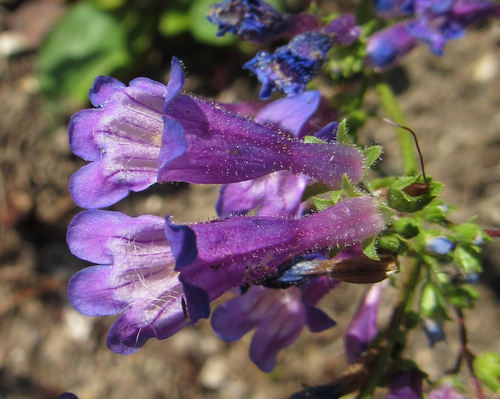
Wilcox's Penstemon
Penstemon wilcoxii
A vibrant jewel of the Pacific Northwest mountains, Wilcox's Penstemon dazzles with spikes of sky-blue flowers that serve as a bustling hub for local hummingbirds and bees.
Quick Identification
Size
Stands 40 to 100 cm (16 to 40 inches) tall; flower clusters are typically 5 to 15 cm (2 to 6 inches) long.
Colors
Brilliant sky-blue to deep violet flowers, often with white or pale throats; dark green foliage that may turn reddish in autumn.
Key Features
- Tubular, two-lipped blue to purple flowers
- Sharply serrated (toothed) leaf margins
- Opposite, lance-shaped leaves
- Smooth, hairless stems often standing upright.
When You’ll See Them
Behavior
Wilcox's Penstemon is a hardy perennial wildflower that plays a vital role in the montane and forest-fringe ecosystems of the Pacific Northwest. Unlike some more delicate garden varieties, this species is a robust grower, often forming small colonies via its woody base. It is a 'pollinator magnet,' specifically evolved to accommodate long-tongued bees and hummingbirds who seek out its nectar-rich tubular blossoms during the late spring and early summer.
In a backyard or wild garden setting, it behaves as a dignified focal point, standing tall even in rocky or nutrient-poor soils. While it doesn't 'move' in the traditional animal sense, its growth cycle is a fascinating display of timing; it waits for the perfect window of soil moisture after the spring thaw to send up its vibrant spikes. It is non-aggressive and serves as a supportive neighbor to other native shrubs and grasses.
EverydayEarth exclusive
Camera Tips
Capturing Wilcox's Penstemon on camera is less about 'trapping' the plant and more about documenting the high-traffic pollinator highway it creates. To get the best results, place your camera on a short tripod or a ground mount approximately 2 to 3 feet away from the flower spikes. Angle the camera slightly upward to capture the interior of the tubular flowers; this is the 'money shot' where you will catch bumblebees disappearing inside or hummingbirds hovering to dip their bills into the nectar.
Because these flowers are most vibrant in late spring and early summer, set your camera to a 'Time Lapse' mode during the peak blooming weeks. A photo every 30 seconds between 9:00 AM and 3:00 PM will create a stunning record of the various insects and birds that visit. If your camera has a 'Macro' or close-focus setting, use it—the fine serrations on the leaves and the tiny hairs inside the flower throat (the 'staminode') are beautiful identification markers that look great in high resolution.
Lighting is your best friend with blue flowers. Early morning or 'golden hour' late afternoon light prevents the bright blues from looking washed out or 'blown out' in digital sensors. If you are using a motion-activated trail camera, set the sensitivity to 'High' to ensure it triggers for smaller subjects like swallowtail butterflies or mason bees. Avoid placing the camera in a spot where tall grass in the foreground will blow in the wind, as this will result in hundreds of 'false trigger' photos of moving weeds.
Similar Species
Species that look similar or are commonly confused with Wilcox's Penstemon.
Frequently Asked Questions
Record Wilcox's Penstemon at your habitat
Connect a camera to start building your own species record — AI identifies every visitor automatically.