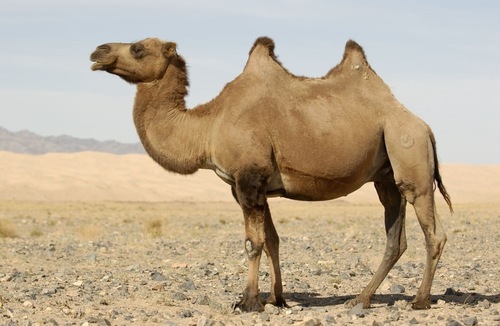
Wild Bactrian Camel
Camelus ferus
A true ghost of the Gobi, the Wild Bactrian Camel is a master of survival in the world's most punishing deserts. With fewer than 1,000 left in the wild, this resilient nomad is one of the rarest sights in the animal kingdom.
Quick Identification
Size
Body length of 2.3 to 3.5 meters (7.5 to 11.5 feet); weight ranges from 450 to 650 kilograms (990 to 1,430 pounds).
Colors
Uniformly sandy-beige to light brown coats with shorter hair than their domestic relatives; lacks the dark, woolly mane on the neck and chest.
Key Features
- Two small, firm, conical humps separated by a wide gap
- Slender legs with broad, flat, two-toed feet for walking on sand
- Distinctive long, curved neck and a flatter skull than domestic camels
When You’ll See Them
Geographic range
Where Does the Wild Bactrian Camel Live?
Native to the rugged heart of Central Asia, the Wild Bactrian Camel is found in the extreme desert environments of Northwest China and southwestern Mongolia. Its primary strongholds include the Lop Nur Wild Camel National Nature Reserve in the Taklamakan Desert and the Great Gobi A Strictly Protected Area in Mongolia. This species lives in some of the most remote and inhospitable landscapes on Earth, far removed from human settlements.
Basemap © OpenStreetMap contributors
Behavior
Wild Bactrian camels are among the most resilient survivors on the planet, adapted to endure the extreme temperature fluctuations of the Gobi Desert. They are highly nomadic social animals, typically living in herds of 6 to 30 individuals, though solitary males are occasionally seen. These herds are led by a dominant bull that guides the group across vast distances in search of food and water. They are notoriously shy and wary of humans, possessing an incredible sense of smell that allows them to detect a threat—or a water source—from several miles away.
One of their most remarkable behaviors is their ability to consume salt water. In areas where fresh water is non-existent, these camels drink from salt-encrusted springs with a higher salinity level than seawater, a feat no other land mammal can replicate. They are primarily diurnal, spending their days foraging and traveling, then resting in open areas at night to remain alert for predators like wolves.
EverydayEarth exclusive
Camera Tips
Capturing the Wild Bactrian Camel on camera is a triumph of patience and planning due to their vast range and elusiveness. The most effective strategy is to locate 'salt springs' or known watering holes in the Gobi or Taklamakan deserts. Since these animals are nomadic, they visit water sources infrequently, so your camera should be positioned to cover the main approach to the water. Mount your camera about 5 to 6 feet high on a sturdy post or rocky outcrop to capture their full height and the characteristic conical humps.
Extreme temperatures are your biggest challenge. In the desert, daytime heat can lead to 'false triggers' on PIR sensors, while nighttime temperatures can plummet, draining batteries. Use high-quality lithium batteries and consider a solar panel attachment if the location allows. Set your camera to a multi-shot burst mode; these camels move with a surprisingly fast, pacing gait, and a single photo might only catch a tail or a nose as they pass through the frame.
Because the environment is incredibly dusty, choose a camera with a high IP (Ingress Protection) rating. Fine sand can easily scratch lenses or jam latches, so a protective security box is recommended. For the best image quality, aim your camera north or south to avoid the harsh, direct east-west desert sun, which can overexpose images. Avoid using strong scents or lures, as these wary animals are more likely to be frightened away by unfamiliar odors than attracted to them.
Similar Species
Species that look similar or are commonly confused with Wild Bactrian Camel.
Frequently Asked Questions
Record Wild Bactrian Camel at your habitat
Connect a camera to start building your own species record — AI identifies every visitor automatically.