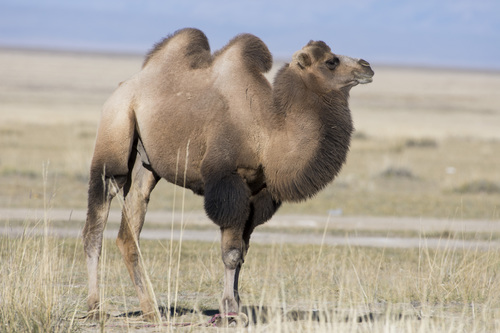
Domestic Bactrian Camel
Camelus bactrianus
The Domestic Bactrian Camel is the two-humped titan of the Central Asian steppes, a resilient survivor built to withstand the world's most extreme temperature swings.
Quick Identification
Size
Height of 1.8 to 2.3 m (6 to 7.5 ft) at the humps; body length of 2.2 to 3.5 m (7.2 to 11.5 ft); weighs between 300 and 1,000 kg (660 to 2,200 lb).
Colors
Shaggy coat ranging from dark chocolate brown to sandy beige; shedding in spring reveals a shorter, lighter tan undercoat.
Key Features
- Two large fatty humps on the back
- Thick, woolly mane around the neck and throat
- Broad, flat, two-toed padded feet
- Sealable nostrils and long double eyelashes for dust protection
When You’ll See Them
Geographic range
Where Does the Domestic Bactrian Camel Live?
Native to the cold deserts and vast steppes of Central Asia, the Domestic Bactrian Camel is most prominently found across Mongolia and Northern China. Its range extends west through Kazakhstan, Kyrgyzstan, and Uzbekistan, reaching into parts of southern Russia and Afghanistan. While their heartland remains the Asian interior, small domesticated populations are now managed on farms and in wildlife parks across Europe, Australia, and North America.
Basemap © OpenStreetMap contributors
Behavior
Domestic Bactrian Camels are highly social and intelligent creatures, historically shaped by their long relationship with nomadic cultures in Central Asia. They typically live in herds and exhibit a calm, stoic temperament, though they are famous for their ability to communicate through various groans, bellows, and the occasional defensive 'spit'—which is actually a regurgitation of stomach contents. They are diurnal, spending the vast majority of their daylight hours foraging and ruminating.
These camels are masters of thermal regulation, capable of enduring temperatures from -40°C (-40°F) in winter to 40°C (104°F) in summer. Their humps serve as a biological pantry, storing fat that can be converted into energy and water during lean times. Unlike many other large mammals, they are not territorial and move across vast distances in search of vegetation, making them the perfect companions for the ancient Silk Road traders.
EverydayEarth exclusive
Camera Tips
When setting up a trail camera for Domestic Bactrian Camels, height is your most important consideration. Because these animals are significantly taller than most backyard wildlife, your camera should be mounted at a minimum height of 5 feet (1.5 meters). Tiling the camera slightly upward can help capture their iconic humps and head, rather than just a side-view of their torso. A wide-angle lens setting is essential if you are placing the camera near a trail, as these animals are long and can easily be cut off in narrow frames.
To attract camels to your camera's field of view, look for communal resources. In arid environments, water is the ultimate draw. Positioning your camera near a well or a trough will almost guarantee frequent visits. Salt licks are another excellent lure; a mineral block placed on a flat rock will encourage a camel to linger, providing you with high-quality, stationary footage. These animals often follow established paths between grazing areas and shelter, so look for wide, flattened trails with large, round footprint depressions.
Be mindful of the seasonal change in their appearance. To capture the Domestic Bactrian Camel in its most majestic state, aim for mid-winter when their woolly coat is thickest. In the spring, they shed in large, ragged patches, which offers a unique, albeit shaggier, photographic opportunity. Because they are diurnal, you won't need to worry much about infrared flash range, but ensuring your camera has a fast trigger speed is helpful for capturing them as they steadily plod past.
Similar Species
Species that look similar or are commonly confused with Domestic Bactrian Camel.
Frequently Asked Questions
Record Domestic Bactrian Camel at your habitat
Connect a camera to start building your own species record — AI identifies every visitor automatically.