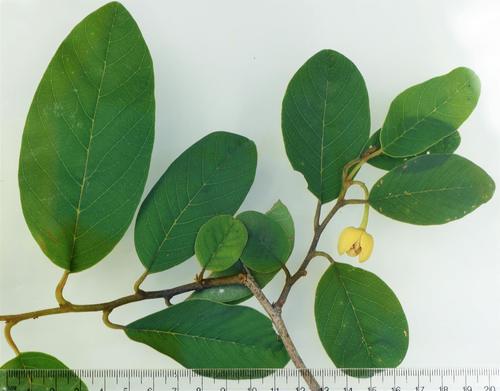
wild custard-apple
Annona senegalensis
The wild custard-apple is more than just a tree; it’s a bustling wildlife hub known for its sweet, apricot-scented fruit and silver-grey bark. A resilient survivor of the African savanna, it draws a colorful cast of birds and mammals to its branches.
Quick Identification
Size
A multi-stemmed shrub or small tree reaching 2–6 meters (6.5–20 feet) in height, occasionally up to 10 meters (33 feet).
Colors
Large bluish-green leaves with velvety undersides; creamy yellow or white flowers; fruit matures from green to a rich orange-yellow.
Key Features
- Broad, ovate leaves with prominent veins and velvety undersides
- Distinctive bumpy fruit with a scale-like surface pattern
- Sweet, pineapple-apricot fragrance from ripe fruit
- Thick, grey-silver bark that is often fire-resistant
When You’ll See Them
Behavior
The wild custard-apple is a hardy, deciduous shrub that defines the landscape of the African savanna. While stationary, it follows a rigorous seasonal rhythm, dropping its broad leaves during the peak of the dry season to conserve moisture. As the first rains approach, it bursts into life with thick, waxy flowers that eventually give way to its famous bumpy, orange fruits.
The tree serves as a vital ecological cornerstone, functioning much like a neighborhood supermarket for local fauna. It doesn't just grow; it interacts with its environment by providing a high-energy food source for various species. Its strategy for survival is rooted in this generosity—by offering sweet, nutritious pulp to animals, it ensures its seeds are dispersed far and wide across the woodland floor.
EverydayEarth exclusive
Camera Tips
Capturing the wild custard-apple effectively requires a shift in perspective; you aren't just filming a plant, but a stage where local wildlife performs. To capture the 'action,' set your camera to a time-lapse mode during the fruiting season. Position your camera on a heavy-duty stake or a nearby branch about 5 feet off the ground, aiming slightly downward at the densest clusters of ripening fruit. AI-powered cameras should be set with a trigger zone specifically around the fruit, as this is where birds and primates will linger longest.
Because the fruit attracts such a wide variety of species, placement is key. For large avian visitors like Turacos or Hornbills, focus your camera on the higher, outer branches where the fruit is most exposed. For primates like baboons or monkeys, a wider angle is better, as they tend to climb into the center of the tree and stay there to feast. To avoid the harsh glare of the midday sun, which can wash out the vibrant orange of the fruit, try to orient your camera facing North or South to take advantage of softer side-lighting during the golden hours.
Don't overlook the ground activity! As the fruit becomes overripe and falls, it creates a secondary feeding zone. Place a second camera at a low angle—about 10 to 12 inches off the ground—pointed at the base of the trunk. This is the best way to capture terrestrial foragers like tortoises, small antelope, and rodents that scavenge the fallen treats. Using a high-resolution setting is recommended, as the intricate texture of the fruit and the tree’s rugged bark make for stunning, high-detail photographs.
During the flowering phase, you can also use macro settings to capture the diverse range of insect pollinators, including beetles and bees, that are attracted to the tree's scent. If your camera supports it, night-time infrared triggers can also reveal nocturnal visitors like fruit bats or bushbabies that come to investigate the sweet aroma after the sun goes down.
Similar Species
Species that look similar or are commonly confused with wild custard-apple.
Frequently Asked Questions
Record wild custard-apple at your habitat
Connect a camera to start building your own species record — AI identifies every visitor automatically.