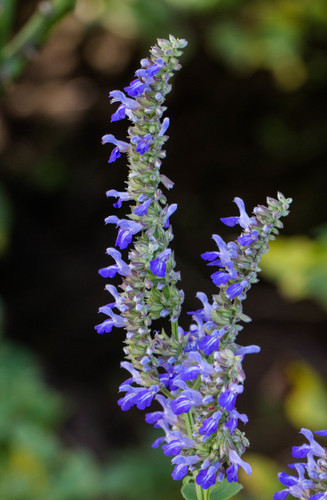
Wild Sage
Salvia polystachia
A towering monarch of the Mexican highlands, Wild Sage paints the mountainsides in shades of deep indigo. This spectacular perennial is a high-altitude haven for hummingbirds and a legendary source of nutritious chia seeds.
Quick Identification
Size
3 to 9 feet (0.9 to 2.7 meters) in height; 2 to 4 feet (0.6 to 1.2 meters) in spread
Colors
Deep violet-blue to indigo flowers; vibrant green foliage with slightly silvery undersides
Key Features
- Multiple dense flower spikes per stem
- Square, herbaceous stems characteristic of the mint family
- Opposite, serrated lance-shaped leaves
- Tall, upright growth habit often reaching 6+ feet
When You’ll See Them
Behavior
Wild Sage is a robust herbaceous perennial that acts as a foundational species in its native highland ecosystems. Unlike many smaller garden sages, Salvia polystachia is known for its impressive height and the sheer volume of its flowering spikes—the name 'polystachia' literally translates to 'many spikes.' In its natural habitat, it remains relatively inconspicuous during the dry season, but it undergoes a dramatic growth spurt once the summer rains arrive, quickly shooting up to tower over other meadow plants.
This species is a vital nectar source for a wide variety of wildlife. It has evolved a symbiotic relationship with its visitors; its tubular flowers are perfectly shaped for the beaks of hummingbirds and the proboscises of large bees and butterflies. While it isn't 'social' in the animal sense, it often grows in dense colonies, creating a blue-tinted haze across mountain slopes that provides essential cover and forage for high-altitude insects and small birds.
EverydayEarth exclusive
Camera Tips
To capture the true beauty of Wild Sage, position your camera at a mid-range height, approximately 4 to 5 feet off the ground. Because this plant can grow quite tall, a low-angle shot looking upward can make the flower spikes look heroic against the sky, while a chest-high placement is better for capturing the pollinators that frequent the blooms. If you are using an AI-powered camera to identify visitors, aim the lens at a cluster of the most vibrant blue spikes, as these are the primary 'landing pads' for wildlife.
Since Wild Sage is a magnet for fast-moving hummingbirds and butterflies, camera settings are crucial. Use a fast shutter speed or 'Sports/Action' mode to freeze the motion of wings. If your camera allows for focal zone adjustment, set it to a narrow range right on the flower heads. Because the flowers are a deep, saturated blue, they can sometimes 'bloom' or lose detail in harsh midday sun. For the best color accuracy and the most activity, focus your efforts during the 'Golden Hours'—shortly after sunrise or just before sunset when the light is soft and the bees are most active.
For a unique perspective, consider a time-lapse setting over the course of late summer. Wild Sage grows rapidly after a rainstorm; capturing one frame every two hours over the course of a week can reveal the fascinating way the 'many spikes' unfurl and reach for the sun. If you are trying to capture specific insects, avoid using heavy scents or lures nearby, as the nectar of the Salvia polystachia is a powerful enough natural lure on its own. Ensure the camera is mounted on a sturdy post, as the tall stems of the sage can sway in the wind and trigger false motion alerts if they are too close to the lens.
Similar Species
Species that look similar or are commonly confused with Wild Sage.
Frequently Asked Questions
Record Wild Sage at your habitat
Connect a camera to start building your own species record — AI identifies every visitor automatically.