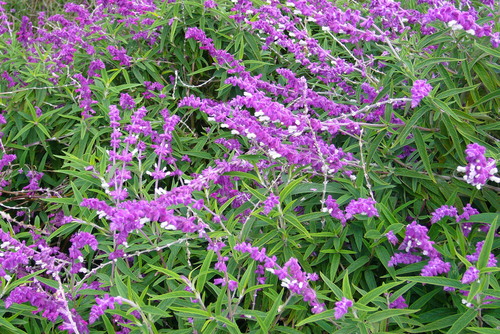
Mexican Bush Sage
Salvia leucantha
A late-season spectacular, Mexican Bush Sage paints the garden in velvety purple hues while serving as the ultimate nectar station for migrating hummingbirds.
Quick Identification
Size
3-4 feet (0.9-1.2 m) tall and wide; flower spikes up to 12 inches (30 cm) long
Colors
Velvety purple or rose-purple calyxes with small white or purple flowers; silvery-green foliage
Key Features
- Fuzzy, velvet-textured purple flower spikes
- Long, lance-shaped leaves with silver undersides
- Arching, fountain-like growth habit
- Square stems characteristic of the mint family
When You’ll See Them
Behavior
Mexican Bush Sage is a vigorous, herbaceous perennial that acts as a late-season anchor for wildlife-friendly gardens. While it spends much of the spring and summer as a dense, attractive mound of silvery foliage, it truly comes into its own during the shorter days of late summer and autumn. Its growth habit is naturally arching, creating a soft, fountain-like effect that provides excellent low-level cover for small garden visitors like toads and ground-foraging birds.
As a nectar-producing powerhouse, this sage exhibits a 'magnetic' behavior toward pollinators. It is particularly famous for its relationship with hummingbirds, who are drawn to the vibrant purple spikes from great distances. Because it blooms when many other garden plants are beginning to fade, it serves as a critical pit stop for migratory species. In human interactions, it is prized for its drought tolerance and deer resistance, as the fragrant oils in the leaves are generally unpalatable to browsing mammals.
EverydayEarth exclusive
Camera Tips
Capturing the action around Mexican Bush Sage requires a focus on its visitors rather than the plant itself. To get the best shots of hummingbirds, mount your camera on a tripod or garden stake about 2 to 3 feet away from the most active flower spikes. Angle the lens slightly upward to catch the underside of the birds' wings and their iridescent throat feathers as they hover. Because the stems of Salvia leucantha are flexible and arching, they tend to sway in the wind; if your camera has adjustable PIR (motion sensor) sensitivity, set it to 'Medium' to avoid false triggers from the plant moving while still catching the fast-moving birds.
Lighting is crucial for this species because of its velvety texture. Position your camera so the sun is behind you or to the side (side-lighting) to highlight the 'fuzz' on the purple calyxes, which creates a beautiful halo effect in photos. Mid-morning light (9-11 AM) is usually the sweet spot, as the nectar levels are high and the sunlight isn't too harsh. If your camera allows for shutter speed priority, aim for 1/1000th of a second or faster to freeze the rapid wingbeats of the hummingbirds and clear shots of bees or butterflies.
For trail cameras used in 'Video Mode,' try to frame the shot so multiple flower spikes are in view. Hummingbirds often 'trap-line,' moving from one spike to the next in a predictable pattern. Setting a short trigger interval (less than 5 seconds) is essential here, as these visitors don't stay in one spot for long. During the peak of autumn migration, you might capture multiple species competing for the nectar, providing fascinating behavioral footage of territorial displays and aerial dogfights right in your backyard.
Similar Species
Species that look similar or are commonly confused with Mexican Bush Sage.
Frequently Asked Questions
Record Mexican Bush Sage at your habitat
Connect a camera to start building your own species record — AI identifies every visitor automatically.